

What Is a B2B Website? How UX Improves Design & Conversions



Quick Summary
B2B website design refers to the process of creating a website that helps a business evaluate the offerings of another brand. It removes friction and confusion from the decision-making process and guides visitors through the stages of their buyer journey.
According to a Forbes study, 70% of B2B websites fail to impress B2B audiences, due to bad UX, unclear messaging, and performance.
Another study shows 88% of B2B buyers will never revisit a website after having a bad experience.
Gartner states that a B2B audience is 40% less likely to complete a purchase in the absence of a clear message.
These factors create friction, and in a B2B sales cycle, friction means loss of leads, and a low conversion rate.
A professionally designed B2B website removes this friction and confusion from the decision making process and guides visitors through the stages of their buyer journey.
What is B2B Website Design?
B2B website design refers to the process of creating business websites that target other businesses to sell B2B software, industry-specific services/ solutions, and professional expertise.
How is it different from B2C web design?
Understanding the basic b2c b2b website design variations helps firms build content, UX, and messaging for wholly different decision-making settings.
Multiple decision-makers
In this web design, priority is given to structuring content to address the requirements of executives, managers, technical evaluators, and procurement teams, and guide them in the decision-making process.
Long sales cycles
These websites need detailed information: features, use cases, implementation, pricing logic, and materials to support long B2B sales cycles across industries.
High-value, high-risk purchases
B2B websites are high-value, high-risk, and the design must reflect that through case studies, proof points, and reviews.
What is a B2B Website?
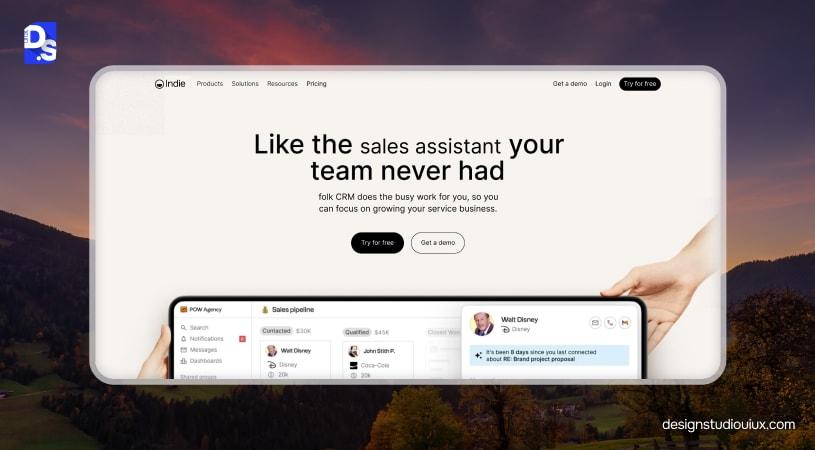
A B2B (Business-to-business) website is a digital product that allows companies to present their offerings to businesses, attract multiple decision-makers, and support long sales cycles. The goal is to inform and educate the target audience and convert them into qualified customers.
B2B websites can discuss their business software, professional services, or e-commerce business model. The best B2B website design examples all have one thing in common: a simple, prominent layout that highlights the core message, and doesn’t obsess over visuals.
B2B Websites Vs. Brochure Websites
B2B websites support lead generation, multiple conversion channels, and multilayered decision-making, whereas brochure websites contain high-level information and a single conversion channel, aka, a contact form.
How B2B Website Design Differs from B2C
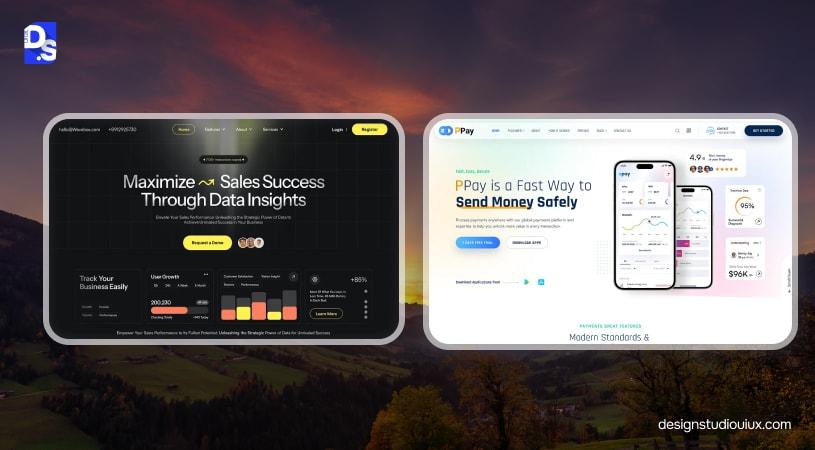
B2B websites serve a business-centric audience, and vary in structure, content quality, and functionality. Here is a quick glimpse:
| Parameters | B2B website | B2C website |
| Decision-makers | Multiple stakeholders | Single decision-maker |
| Content Depth | In-depth technical content, mostly informative | Shorter, engaging, and persuasive content, |
| UX Complexity | Complex UX to support long buyer journey | Simpler, with shorter buyer journey |
| Conversion Paths | Demos, quotes, discovery call, consultation | Instant purchases, Add to Cart |
Content Depth
The primary goal of B2B website design is to educate audiences through each stage of their buyer journey. B2B buyers are not impulsive, and in most cases, researchers are not the final decision-makers.
For example, a marketing manager might initially research a tool and present the findings to the higher-ups. He needs in-depth articles and product information to convert first, and decide whether to go forward or not.
He would need:
- Comprehensive buying guides
- Blogs, demos (videos), case studies, and social proof.
- Service-based websites should highlight their team members, their expertise, and their past experiences
A decision-maker needs even more handholding. So your website should contain data about the pricing, post-purchase support, and proof about ROI.
B2C websites prioritize emotional, and hooking content to attract the buyer’s interest. The main goal is to persuade them to purchase without leaving the site. So they usually contain visual elements and concise content to create a positive impression on the consumer’s psyche.
Decision-makers
Decision-making is not linear in B2B; it involves multiple stakeholders. Researchers also spend a lot of their time researching and comparing. To accommodate this long sales cycle, a B2B website should maintain user engagement through its value-driven content.
In B2C, decision-making is shorter, as it does not involve multiple stakeholders and consumers are driven by their personal preferences and emotional responses.
UX Complexity
In B2B, researchers have varying search intent, like initial research, evaluation, and final comparison. According to B2B website design best practices, your website should have role-based pathways, leading users to solution pages, industry pages, technical documentation, case studies, and finally, pricing structure.
B2C web design mainly prioritizes speed and minimal friction during browsing/ purchase. This can be achieved through categorization, visuals, and product grids.
Conversion Paths
B2B conversion paths end when users get enough reassurance and context through demos, consultations, trials, or quotes. B2C conversion paths are simpler and more transactional than their counterparts.
Core Elements of High Performing B2B Websites
A high-performing B2B website UX supports these characteristics- proper positioning, Information Architecture, UX for Multiple Personas, and Trust Signals to signal credibility and boost conversion.
Clear Positioning & Messaging
You have a few seconds to convince users that “you got what it takes” to solve their challenges. These researchers are not passive scrollers; they are actively looking for solutions/ information. So, your homepage should feature your brand’s value proposition to quickly capture their attention.
Information Architecture
A B2B Information Architecture structures the content and layout to help visitors land on the specific page. A strong IA maps the website content to guide decision-makers through the sales funnel, from awareness to the consideration stage.
UX For Multiple Personas
The B2B UX strategy accommodates researchers, evaluators, and executive decision-makers, their journeys, and addresses their queries. These groups may look for particular information, depending on their search intent, frequency of visits, and expertise. So your website should have case studies and in-depth articles to address their concerns.
Trust Signals
Credibility and trust are top concerns in B2B, and without social proof, your website is not worth it. This can be countered by adding logos of previous clients above the fold on the home page, highlighting before-and-after statistics, and case studies.
Conversion Paths
The conversion path of high-performing B2B websites may lead to these outcomes: demos, consultations, PDF download, or signups. All these paths should be accompanied with a clear and prominent CTA for quick actions.
How to Design a High Converting B2B Website
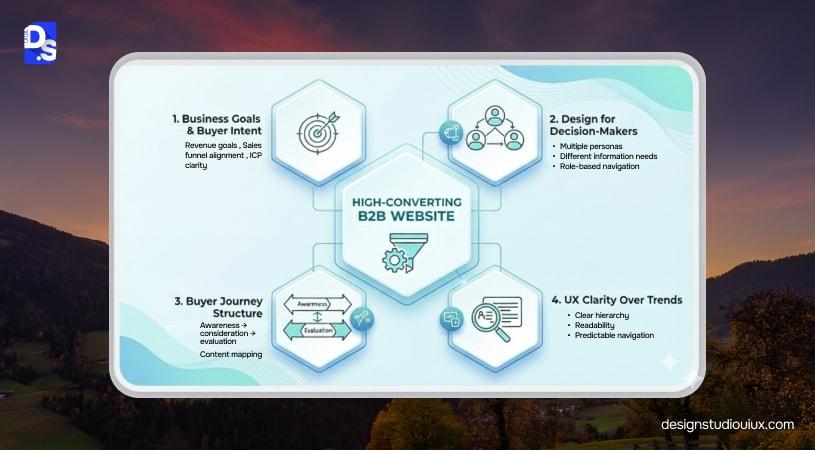
Till now, we discussed the characteristics of a successful B2B web design, now let’s focus on the designing part.
Start with Business Goals & Buyer Intent
Before designing the website, you should understand your business or conversion goals. So first:
- Decide how the website should contribute- lead volume, MQL, or demo requests
- Map website pages to sales funnel stages, necessary to avoid duplication
- Identify the target ICP to curate the core message
When all these are checked, you will have a revenue-generating website, not only a marketing asset.
Design for Decision-Makers, Not Just Users
As established earlier, each stakeholder plays a role in decision-making, so your website should be tailored for executives, technical evaluators, and consumers. The pages should address information needs of these groups, whether it be specifications, case studies, or social proofs. For better results, you can add role-based navigation, to help each person land on the appropriate page.
Structure the Website Around the Buyer Journey
Your B2B should offer a seamless journey at each buyer journey stage by following these rules:
- Awareness- Address the pain points and mention possible solutions
- Consideration- Focus on comparative, in-depth content and blogs
- Decision- Add social proof, case studies, and statistics to help decision-makers validate their choice
By following this structure, you can provide the right information to the audience, instead of just overwhelming them during their journey.
Prioritize UX Clarity Over Visual Trends
The audience demands clarity on how a particular brand can benefit, and what separates that brand. While working on B2B web design, priority should be given on maintaining a clear hierarchy, content readability, and using a simple yet predictable navigation. All these things will help you to get your message across the board and convert your consumers.
Make Conversions Obvious and Low-Friction
In B2B, users don’t just click on the first CTA button they came across, it’s a gradual process. They might first click on “Download Whitepaper” first, then proceed to a “Product Demo”, and then “Book A Consultation”.
So, your homepage already has prominent primary CTAs, but they should be supplemented by thoughtful secondary options. Using trust elements (social proof and credibility) near these buttons can make the conversion intuitive.
B2B Website Design Process
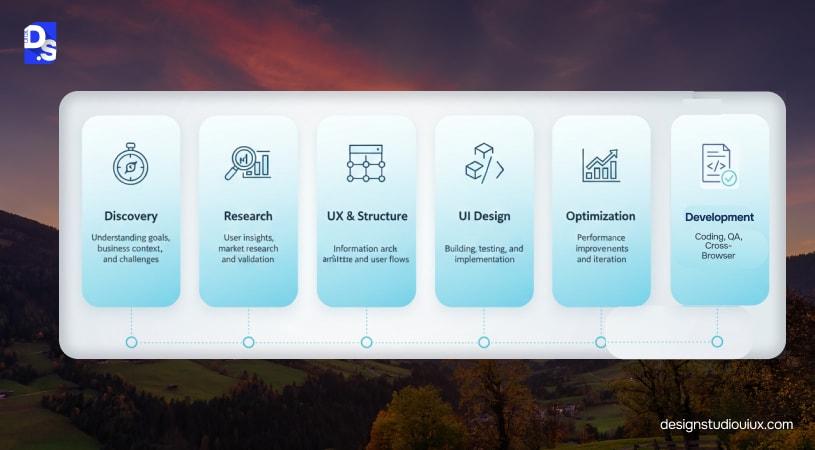
The B2B website design process involves these 6 stages: discovery, research, UX, UI design, development, and optimization. Let’s go through them one by one:
Discovery
The discovery phase involves learning about the brand, its unique value proposition and its ideal buyers through interviews, research, competitive analysis, and Search Engine Optimization research.
Research
In the second stage, extensive research is done about the target audience or prospective clients. The collected insights will then be converted into data, to be used later in the web design process.
UX & Structure
Developers will focus on these factors while working on the B2B website’s UX:
- Information Architecture
- Site navigation
- Page elements
- Content structure
- Lead capture mechanism
- Page layout
UI design
After the UX is finalized, the team moves on to the designing phase, deciding the branding elements (color, logo, and iconography). The home page is designed first, and then the remaining pages are designed, keeping the overall look intact.
Development
After frontend development, the team focuses on developing the website’s backend. Here, all the custom features and functionalities are added, while maintaining W3C best practices, and SEO navigation.
Optimization
Last but not least, the quality assurance team takes the lead to analyze the website for performance issues. Based on their findings, the website is further optimized to ensure zero friction across every touch point before being launched.
Common B2B Website Design Mistakes To Avoid in 2026
You have developed a B2B website, but it has negligible traffic.
Unknowingly, your B2B web design may have these UX issues.
Many of these mistakes occur when businesses blindly follow outdated layouts instead of aligning with evolving B2B web design trends.
Feature-heavy messaging
B2B websites will always lean towards technical jargon, that’s a given.
The issue arises when the home page overdoes it.
Your audience is there to understand how you benefit their case, not go through a long list of specifications. If the messaging is not direct, you will have a significantly high bounce rate, lost leads, and low conversation rate.
Poor navigation
Buyers cannot find information quickly because of cluttered or inconsistent navigation. Facts show that:
- 55% of visitors would evaluate navigation and layout after landing on a page.
- People will leave if they cannot access information in 3 clicks
- 60% of people will never revisit if they found the navigation confusing
Poor navigation might impact the visibility of high-intent pages, leading to fewer qualified visitors.
Weak CTAs
CTA buttons play a significant role in B2B website design, prompting users to make a specific action. However, generic or weak CTAs can derail an otherwise good experience simply if they don’t match with the intent of buyers. Generic CTAs like “ Learn More”, and “Click Here” are documented to have 30% lower CTR (Click Through Rates) and fewer conversions.
Ignoring SEO & UX Alignment
Sometimes, B2B websites focus too much on aesthetics, rather than aligning UX with SEO parameters. As a result, they don’t show up on results for the right search intent, impacting overall discoverability and rankings.
When Should a B2B Website Be Redesigned
The short answer is whenever your website stops supporting your buyers in their journey, or you are not seeing business outcomes. Here are the crucial website redesign signs you need to consider:
High bounce rate
An alarmingly high bounce rate means your website is failing to address your audience’s pain points. That’s why they are not exploring or interacting with other pages, and leaving just after landing on the home page.
Poor conversions
A non-converting B2B website is a red flag. If it does not capture contact information, or generate requests for quotes, generate leads, or sell anything, then there’s no point.
The conversion rate can be affected by poor navigation, weak CTAs, wrong content, or wrong target audience. Once you identify the reason, you can consider redesigning your website.
Outdated UX
Every few months, businesses should audit their website’s UX.
You should check the website’s visuals, mobile-responsiveness, speed, and overall structure.
If your website’s UX is confusing, you will lose their trust, and the overall credibility.
Business pivot
Sometimes, businesses may pivot its branding, which means, newer ICP, products, market, and pricing. If you have undergone this change, then your website needs redesigning, to express the same message across all channels. Otherwise, not focusing on B2B web design will dilute your brand’s presence, leading to missed opportunities.
How to Choose A B2B Design Agency
It might be tempting to pick the first option from your list of B2B web design agencies, but remember, this is a business decision with a long-lasting impact. The website should not be just visually appealing, it needs to support the long sales cycle as well. Here are the things to consider:
UX Expertise
B2B websites never target a single user, they target teams and decision-makers. Their UX needs to support their search intent. So, the first thing to evaluate is an agency’s UX expertise. The agency should have a set procedure including user research, persona development, buyer journey, Information Architecture, and designing for conversion.
Industry Understanding
All B2B websites are not equal, they vary across industries, such as fintech, manufacturing, logistics, and healthcare. A B2B website design agency should understand this core difference, and all the related things, such as ICP, compliance, content patterns, buyer journeys, and industry-specific challenges. During the evaluation, check the agency’s portfolio and case studies to gauge its expertise.
Process Transparency
The last thing to evaluate is the agency’s transparency about the B2B web design process. The agency should have a well-defined process involving research, UI and UX strategy, content strategy, development, and testing before the final launch.
Designstudio UI/IUX follows a research-driven B2B website design process to create websites that offer clarity, and have high-conversion rates.
Conclusion
A successful B2B website design is more than attractive visuals, it involves a deep understanding of the buying process, pain points, and conversion paths. When these elements come together, the result is a website that elevates your brand, supports sales teams, and helps decision-makers move from research to evaluation without friction.
Throughout this blog, we discussed the core elements, common web design mistakes, and distinction between a digital brochure and a proper B2B website.
Book a Discovery Call for a revenue generating B2B website.
FAQs
What makes a good B2B website?

A good B2B website communicates what the company does, who it serves, and why it matters. It offers structured content for different decision-makers, builds trust with proof points, and provides simple, low-friction paths to convert.
How much does B2B website design cost?
The cost to design a B2B website may fall anywhere between $5000 and $30,000. It may vary depending on certain factors, such as feature complexity, pages, chosen platform, and additional integrations.
Is SEO important for B2B websites?
Yes, SEO is important for B2B websites to establish authority and credibility, increase visibility and traffic, build a brand’s lead generation pipeline and boost revenue.
How long does B2B website design take?
The timeline for B2B website design may vary, from 3-5 weeks to 6+ months. However, a typical B2B website might take 10-15 weeks, from discovery to post-launch optimization.
What pages should every B2B website have?
A B2B website should have a well-designed Home Page, About Us, Services/ Products, Case Studies, Blog, and legal/ compliance related pages (Privacy Policy, Terms and Conditions), and Return/ Refund Page for B2B e-commerce websites.