


B2B vs B2C Website Design: UX, Strategy & Examples



Quick Summary
B2B website design emphasizes content depth, credibility, low-commitment, and structured navigation to gain user’s trust and convert. B2C website design is more streamlined with action-based CTAs, mobile-based interactions, and simplified checkout for fast purchase cycles.
Most websites on the internet are mainly classified into two categories, B2B (business to business), and business to consumer (B2C).
They might look similar at a glance, but they are built for different target audiences, goals, and user behavior. Basically, the main difference lies in UX. It actually shapes how users make purchase decisions, especially in B2B.
Although both categories should have structured UX, B2B conversion depends on clarity, confidence and social proof. B2C UX helps people to quickly discover products, and motivate them for faster decision-making.
What is B2B Website Design?
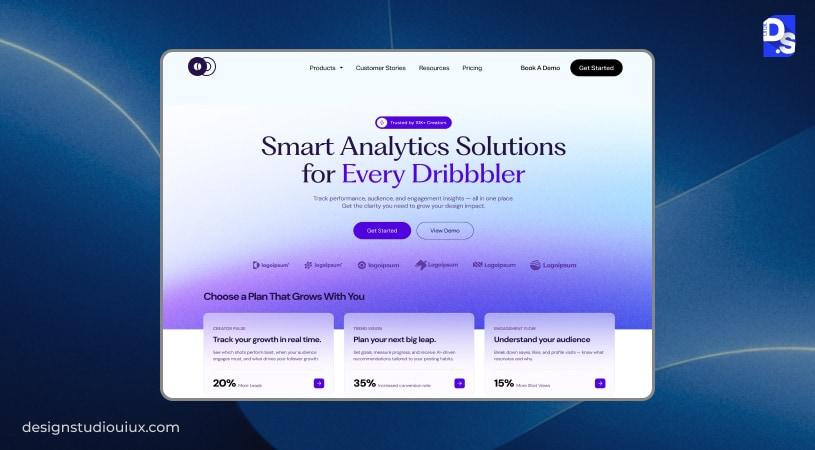
B2B website design involves creating highly-engaging professional websites that cater to other businesses. These websites are designed to sustain long and complex buying journeys by providing a consistent and clear user experience.
Decision-maker complexity
A B2B website design agency is aware that B2B user journey is multi-faceted, involving executives, department heads, technical evaluators, and procurement teams. So they create a uniform and consistent web design that:
- Address different stakeholders without breaking
- Combines technical detail and strategic messaging
Long Sales Cycle
In B2B, consumers will visit multiple times before making a decision, creating a non-linear sales cycle. Effective B2B website design support:
- Revisits with a clear information hierarchy
- Decision-making by offering progressive content depth
- Intent matching and lead nurturing through soft CTAs
Enterprise trust signals
Research shows that B2B audiences prioritize authority and trust, and look for case studies, testimonials, and brand logos.
What is B2C Website Design?
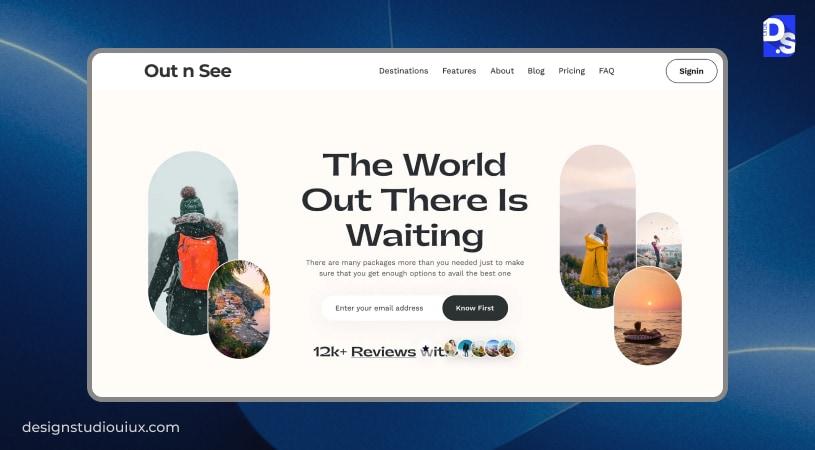
B2C website design mainly focuses on creating business websites that directly target customers. A B2C website can sell to customers or intermediaries, but they don’t usually target other businesses.
Emotional triggers
B2C UX capitalizes emotional triggers to shape user behavior and decision-making models. They do this through:
- Visual hierarchy that draws attention
- Microinteractions that create a pleasing user experience
- Appealing images and copy that directly speaks to their subconscious
Fast Conversions
Unlike B2B, conversion happens fast in B2C. So, to optimize the interface, a B2C web design agency would focus on:
- Minimize steps and remove unnecessary inputs
- Eliminate friction from checkout points to reduce drop-offs
- Immediate feedback loops to keep users moving
Product-first navigation
The navigation plays a significant role in shaping B2C buying decisions. An optimized navigation would:
- Expose products within the first interaction
- Consists of advanced features, filters, search options, and comparison tables
B2B vs B2C Website Design: Core Differences
| Factor | B2B Website Design | B2C Website Design |
| Primary goal | Lead generation and authority building | Quick purchase and engagement |
| Buyer type | Multiple decision-makers | Individual customers |
| Decision time | Weeks/ months | Days/ Minutes |
| UX Flow | Role-based | Simple |
| Content Style | Whitepapers, case studies | Emotional-storytelling, offers |
| CTA | Book Demo/ Contact Sales | Buy Now/ Add to Cart |
| Navigation | Detailed Information Architecture | Flat |
| Branding Tone | Professional | Bold |
| Metrics | LTV, MQL, Demo Rate | Conversion Rate, AOV |
| SEO Focus | Industry Keywords | Product & Trend keywords |
B2B Vs B2C UX Design Differences
Information Architecture
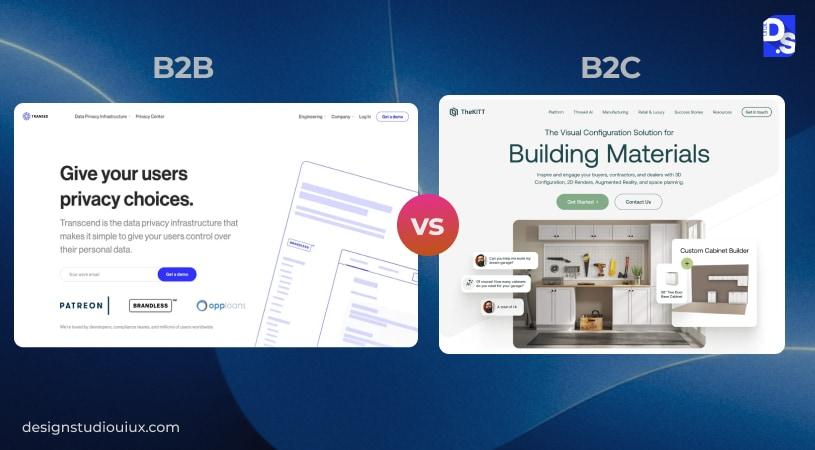
In B2B, consumers need time to understand the product, integrations, pricing logic, compliance, and the long-term value. The website’s Information Architecture should accommodate that, by organizing the content in layers.
Here, the main focus is to keep users engaged without deviating from the context.
According to UX research services, B2C UX is optimized for speed, helping users to quickly reach the destination (product page). It is designed to encourage impulse behavior, in comparison to critical thinking.
Copy Tone
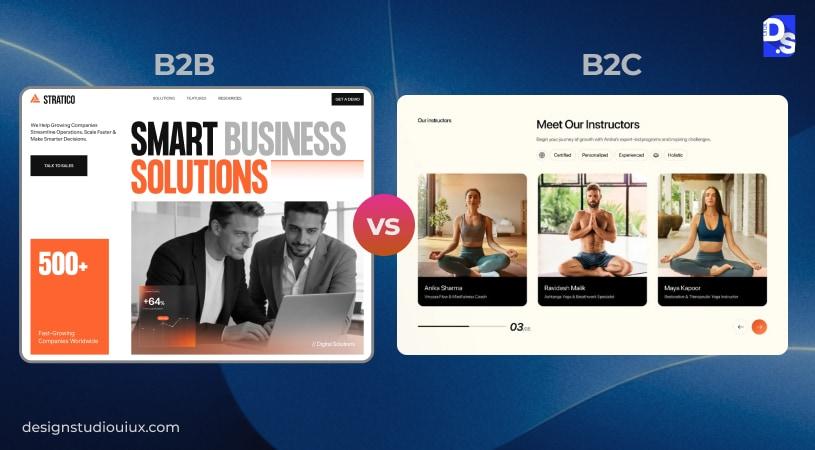
The content style reflects how users think across the industries. B2B copy should be clear and confident and straight to the point. People should have enough information to defend their decisions.
In B2C, the content should be emotion-driven, and must tell a story. Here, the features are highlighted, but not over-explained, like in B2B.
Visual Hierarchy
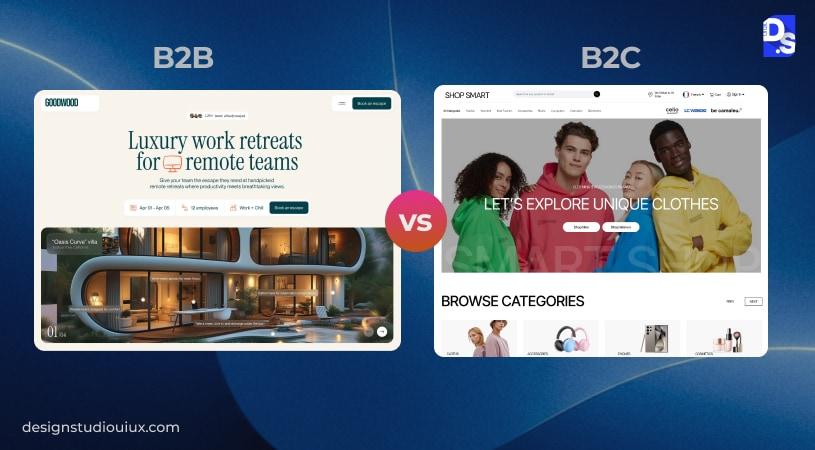
Visual hierarchy is the primary differentiator in b2b vs b2c ux, as it serves different goals. Readability matters most in B2B, people must access the complex information without getting overwhelmed.
In B2C, the interface needs to draw the user’s attention. The visual hierarchy should include strong imagery, contrast, and color themes to persuade the user to buy products.
Onboarding Flow
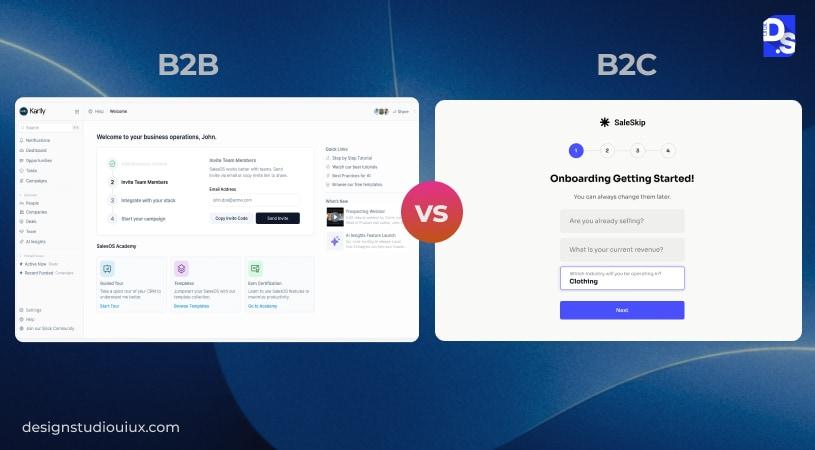
B2B products are complex, and people need to learn their usage. The onboarding should explain the features, how they work, and the overall core value.
B2C onboarding is not that complex, and requires minimal steps.
Mobile vs Desktop priority
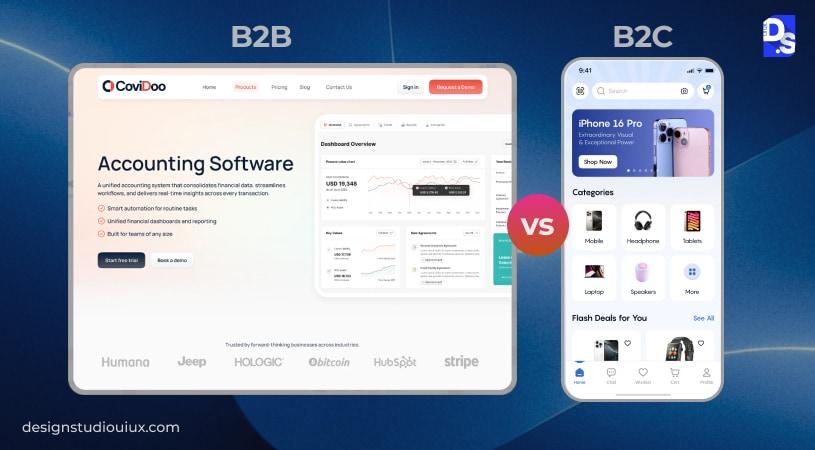
B2B UX is desktop-first, designed for long and detailed work sessions/ environments. Mobile often plays second fiddle here. B2C UX is more geared toward mobile-first, and optimized for fast interactions/ impulse buying.
Conversion Funnels: B2B vs B2C
B2B Conversion Funnel
B2b vs b2c conversion differs in how a brand gains the user’s confidence. In B2B, the goal is to reduce uncertainty across the funnel without being too pushy.
The funnel itself is not linear, users move between the stages (awareness, consideration, decision, and post-conversion) Also, multiple decision-makers (buyer, evaluator, and approver) will enter the funnel at different points.
Here is how the UX should work according to funnel stages:
Awareness:
The website should help users understand the value proposition.
Consideration:
Comparison pages, case studies, product walkthroughs, and documentation all help in optimizing cognitive load.
Decision
Pricing clarity, security cues, demos, FAQs, and human contact options help users feel safe committing.
Post-conversion:
Onboarding, dashboards, and support experiences directly impact retention and expansion.
Now, let’s check how B2C conversion happens according to the funnel stage.
Awareness:
Visual hierarchy and emotional cues are used to quickly grab user’s attention and keep them engaged.
Consideration
Users move through reviews, ratings, and images to make fast decisions, without going in too deep.
Decision
For this stage, the website should include guest options, simple checkout flows, and CTAs to prevent bounce rates.
Post-conversion
In this stage, the goal is to reinforce user satisfaction by employing features such as
- Order tracking
- Confirmations
- Easy returns
KPI Examples
B2B conversion depends on these KPIs:
- Demo request completion rate
- Content depth (case studies, pricing, docs)
- Lead quality
B2C conversion depends on:
- Conversion rate
- Cart abandonment rate
- Time to purchase
- Average order value
CTA Psychology
B2B CTAs should be low-pressure, such as “Book A Demo”, “Talk to An Expert”, and “View Case Study”. They should prompt people to take the next step, without requiring cognitive effort.
B2C CTAs are more action-oriented, “Add to Cart”, “Buy Now”, and more direct, compared to B2B buttons.
Real World B2B & B2C Examples
B2B Web App UX Design Case Study
This B2B web app UX case study involved redesigning a complex B2B dashboard used by multiple internal roles to monitor data and complete task-critical workflows.
The challenge:
Users felt overwhelmed by cluttered layouts, unclear priorities, and inconsistent interaction patterns. Decision-makers and operators were constantly switching contexts, leading to errors and frustration.
Our UX approach:
- Simplified the information hierarchy so key metrics and actions were visible without overload
- Designed role-adaptive views that surfaced relevant data based on user needs
- Clarified workflows with better feedback, grouping related tasks, and predictable navigation
Outcome:
Users were able to grasp status and complete complex tasks more efficiently. Adoption increased because the interface felt predictable, purposeful, and confidence-building. Instead of fighting the UI, users could focus on decisions.
B2C ECommerce Website UX Case Study
This ecommerce website UX needed better alignment between search intent, product discovery, and conversion flows.
The challenge:
Users were arriving through search, but many exited before purchase. The analytics showed high bounce on category pages and hesitation at product detail screens.
Our UX approach:
- Improved scannability with clean product grids and hierarchy
- Enhanced filtering and sorting so users find what they need faster
- Built content pathways that match search behaviour and intent
- Refined CTAs to reduce hesitation in the checkout path
Outcome:
Engagement increased as users found what they were looking for more quickly. Checkout abandonment decreased because the journey felt smoother and more intuitive. The ecommerce experience started working with user expectations instead of against them.
SaaS App Design Case Study
This SaaS app design focused on helping new users understand core value quickly without drowning in complexity.
The challenge:
The product was powerful but overwhelming. New users often dropped off before hitting their first success milestone, missing the “aha” moment that drives retention.
Our UX approach:
- Cleared the onboarding path with contextual guidance and progressive disclosure
- Designed task-oriented flows that help users complete meaningful actions quickly
- Increased clarity in interface language and visual cues so users understand, not guess
Outcome:
Onboarding completion rates improved, and users reached value faster. The experience now feels empowering, not intimidating—helping the SaaS product grow consistent, enthusiastic usage.
SEO & AEO Strategy For B2B vs B2C Websites
A comprehensive B2B B2C SEO strategy aligns content, website structure, and UX to gain visibility and ranking. While the basics remain the same, the execution strategy might differ depending on intent, urgency, and evaluation.
Schema usage
B2B websites
B2B SEO benefits from elements that bring authority and trust to the website, instead of just answering “what is B2B website design”. In most cases, Article, FAQ, and organization schema support research-driven and comparison-based activities.
B2C websites
B2C websites target quick conversion through Product, Offer, Review, and Rating schema. If deployed correctly, users can easily see prices, availability, and social proof, helping in more visibility and ranking.
Blog clusters
For B2B, blog clusters should be around specific solutions for pain points, targeting people at different stages of the buyer’s journey.
In B2C, the blog clusters should be around buying intent, trends, and products. Here, comparison-based content, seasonal guides, and “best of” lists capture the user’s intention, and encourage them to make a purchase.
GEO pages
Page content should be clearly structured to be optimized for AI citation or summarization. It consists of clear definitions, step-by-step explanations, comparison tables, and strong internal linking between blog and service pages is a must for B2B.
For B2C websites, scannable product descriptions, benefits, & FAQs help B2C websites to be visible among the top searches.
Case study linking
Case studies should be internally linked to high-traffic blog and service pages to close/ seal the deal. These are better suited for B2B, while in B2C, user reviews, stories, etc. serve a similar purpose.
FAQ strategy
FAQs also play a vital role in B2B B2C SEO strategy, especially for visibility. These are used to remove mental friction by answering questions that linger in the back of people’s mind.
In B2B, FAQs should be centered around “why”, “how”, and “what will be the impact” questions. For B2C websites, these questions should address concerns about shipping, returns, usage, and product delivery guarantees, along with “what is B2C web design”.
Quick Checklist: Choosing B2B or B2C Design
So, which web design is appropriate for your brand? Here’s a quick checklist to help you with decision-making:
- Who is the target audience?
- Who are the decision-makers?
- How long is the sales cycle?
- How do users arrive at a decision? Do you need detailed content or concise information?
- How do they access the website (device mode)?
- Do users act within a single session or are they repeat visitors?
- How is success measured by lead quality or transaction volume?
- Does a single conversion depend on input from multiple users?
- What type of trust signals do they need?
Conclusion
B2B websites need to support slow, high-stakes decisions, as users arrive with questions, return multiple times, and involve others before committing. Strong B2B UX focuses on clarity, credibility, and structure, helping users understand value, reduce risk, and build confidence over time.
B2C websites, on the other hand, are designed for momentum. Users act quickly, compare less, and rely more on emotion and reassurance. Here, UX must remove friction, surface products immediately, and make every step toward purchase feel effortless.
Problems usually arise when a B2B website pushes hard CTAs too early, or when a B2C website overwhelms users with explanations they don’t need. To get rid of all those problems, learning from effective B2B web design inspirations is a smart choice. High-performing websites don’t follow trends; they follow user intent.
If conversions feel inconsistent or drop-offs happen at key moments, it’s often a signal that the UX doesn’t match how your audience decides. A focused UX audit can reveal whether your website is designed for the right behavior.
FAQ’s
What is the difference between B2B and B2C website design?

B2B website design emphasizes creating web pages that sustain long decision cycles and build trust. On the other hand, B2C web design focuses on creating visually engaging websites with simpler navigation and prominent CTAs.
How do I know if my business needs a B2B or a B2C website design?
Businesses that target other businesses to sell products or services should go with B2B website design. B2C website design ideal for companies selling products or services directly to customers.
What are examples of B2B & B2C Website Design?
B2B web design examples include enterprise SaaS platforms, CRM systems, UX agency websites, and industry-based websites. B2C web design examples include eCommerce websites, lifestyle websites, and consumer-centric platforms.
Can a single website target both B2B and B2C audiences?
The simple answer is yes, in fact, there are many B2M (Business to many) websites that target both B2B and B2C audiences. These have separate user journeys, CTA alignments, and contextual navigation to support intent-driven entry points.
How does user experience differ in B2B vs B2C websites?
In B2B, UX should prioritize clarity, credibility, and content depth, supported by detailed content, structured navigation, and trust signals. In B2C, UX design prioritizes fast action, speed, and emotional impulse buying through product hierarchy, visual cues, and streamlined checkout processes.
What type of CTA works best for B2B compared to B2C websites?
B2B CTAs should be nurturing and low-commitment to match longer user journeys. B2C websites include direct and action-driven content to support emotion-driven decisions.
Are B2B websites more expensive to design than B2C websites?
Yes, B2B websites tend to be more expensive to design than B2C websites, mainly due to UX complexity, forms, navigation, and Information Architecture. B2C websites usually focus on faster journeys, and the underlying UX is typically less complex, which means designing them is less expensive.
Do SaaS products follow B2B or B2C design principles?
SaaS products may follow B2B and B2C design principles, depending on who the target audience is. B2B SaaS leans toward clarity, role-based dashboards, onboarding that explains value over time, and CTAs like Book a Demo or Start Free Trial. B2C SaaS focuses on instant usability, emotional reassurance, minimal setup, and quick wins right after sign-up.