


UX Strategy: What It Is & How to Build One (2026)


What is a UX Strategy?
A UX strategy is the decision making design framework that outlines exactly what a product’s user experience should accomplish and how design work will achieve that goal.
The term “user experience,” or “UX” is used to represent of the qualities of a decent digital product or service.
UX strategy involves planning the overall design approach to align with business goals and user needs. It ensures a cohesive and purposeful user experience, integrating design seamlessly into the broader organizational strategy.
Difference between UX Strategy vs UX Design
UX Design is about building the website screens, buttons, and paths users navigate and UX strategy is about deciding what to build, who to build for, and the purpose behind it.
The Important Elements of UX Strategy
According to reputed design agency Nielsen Norman Group,UX strategy is a 3-part plan. The three primary components of this plan are:
Practical Vision and Goals
A brand must have a clear understanding of its current market status, what they are trying to achieve, and the roadmap to get there.
- This includes understanding the key problems of its target users/customers.
- It also means devising ways to support their broader needs.
- The vision must be grounded in real user research, and not rely on any assumptions or internal preferences.
Define Success
Defining success means deciding the tricks of UX strategies before design begins, i.e. exactly how you will know when the UX strategy is working.
Once a brand has a clear idea of what “success” should be in terms of addressing user needs, it must establish definite ways to measure progress. Goals, KPIs, and other metrics must be defined to measure UX improvements.
- Some common UX success metrics are task completion rate, Net Promoter Score (NPS), System Usability Scale (SUS), conversion rate, error rate, and customer satisfaction (CSAT).
- Without predefined metrics, you can measure the UX improvements.
A Comprehensive UX Design Plan

Your design plan is the “how-to” guide/operational guide for the UX strategy. It maps out the exact design activities, deadlines, and checkpoints needed to turn your current product into the final version you want.
Finally, a brand must have the plan to ensure that it can accomplish each goal on the path to UX success. These goals should be broken down into simple objectives and milestones.
This aspect of creating a UX strategy helps designers prioritize specific tasks and address any persistent uncertainties related to their UX design.
All three of these components are related to the overall business strategy. A UX strategy should:
- clearly define the product vision,
- describe the results that we aspire to achieve for the brand and for the end-users, and
- outline clear plans for reaching each milestone on the path to UX success.
There are too many digital products/services that you are competing with.
So, a new-age UX strategy has to ensure that your app/website is fulfilling what you’ve promised to your customers in ways that your competitors cannot.
If you have 3 or more digital competitors, people will drop your product after only 2 or 3 bad user experiences.
So, it is mandatory to follow a proper UX strategy to build UX that prevents churn.
This competitive pressure is felt most acutely by early-stage companies, where UX design for startups requires balancing speed, limited resources and the urgent need to find product-market fit, all at the same time.
That’s where UX research services come into play, offering invaluable insights into user behavior and preferences, helping you stay ahead of the competition. Curating a future-proof UX strategy is an ongoing process.
How to Create a UX Strategy?
You do not need a detailed document to create a UX strategy. You need a clear plan based on real user needs, which are as follows:
- Review your product- Conduct UX audit and look at the full user journey. Find where users face issues and compare your product with similar ones.
- Understand your users- Collect feedback through interviews, surveys, and user sessions. Find out what users want and where they struggle.
- Choose your goals – Decide what success looks like in the next 12 to 24 months. Measure it with KPIs such as completion rate, conversion rate, NPS, and fewer errors.
- Create a roadmap – Turn research into action. Rank tasks by priority and plan who will do them and when.
- Update regularly – A UX strategy should change as users and products change. Review it often and improve it using fresh feedback.
UX Strategy in Practice: Key Takeaways
Having a UX strategy document is one thing, living by it is another.
Here, the real struggle is making your day-to-day work match the plan.
Key Points:
- Brands are asked to create UX strategies because it is the “big-picture” that covers all of these details and aligns them with their short and long-term business goals.
- Curating a future-proof UX strategy involves a lot of research, investment, planning, and constant refinement.
- Start off with a basic UX strategy for your app/website based on the three components mentioned above.
- From visual design to interface design to content messaging: a new-age UX design strategy will cover every user touchpoint.
- Build a better understanding of your users’ behavior with time by tracking their behaviors on your app/website.
- UX strategies also need to be aligned with existing market conditions and competition.
- Constantly refine your UX strategy as per your users’ changing behaviors and preferences.
- Build brand loyalty and advocacy on a long-term basis by fulfilling your users’ expectations every time they interact with your digital product.
Why Creating a UX Design Strategy is Important

Great design bridges the gap between user needs and business targets for smooth growth. It prevents costly mistakes during development and significantly increases customer loyalty.
According to research, if you spend a dollar on UX, it will surely return upto $100 and this is a 9,900% ROI for your brand. Also, companies with strong design strategies often outperform the S&P index by around 219% over a 10 year period.
For professional UX designers, a well-defined UX strategy is often the differentiator between success and failure. It serves as the “vision” your team needs to formulate the same mental model for your future app/website.
It is also worth understanding how this responsibility is shared, the distinction between a UX designer and a product designer often determines who owns and drives the UX strategy within a team.
Performance of an App With Well Defined UX Vs. Unclear UX Strategy
Here is a chart detailing the design journey of two apps: one has a well-defined UX strategy, and the other does not.
Notice how these two apps perform when faced with unique challenges during different stages of the app design and development process:
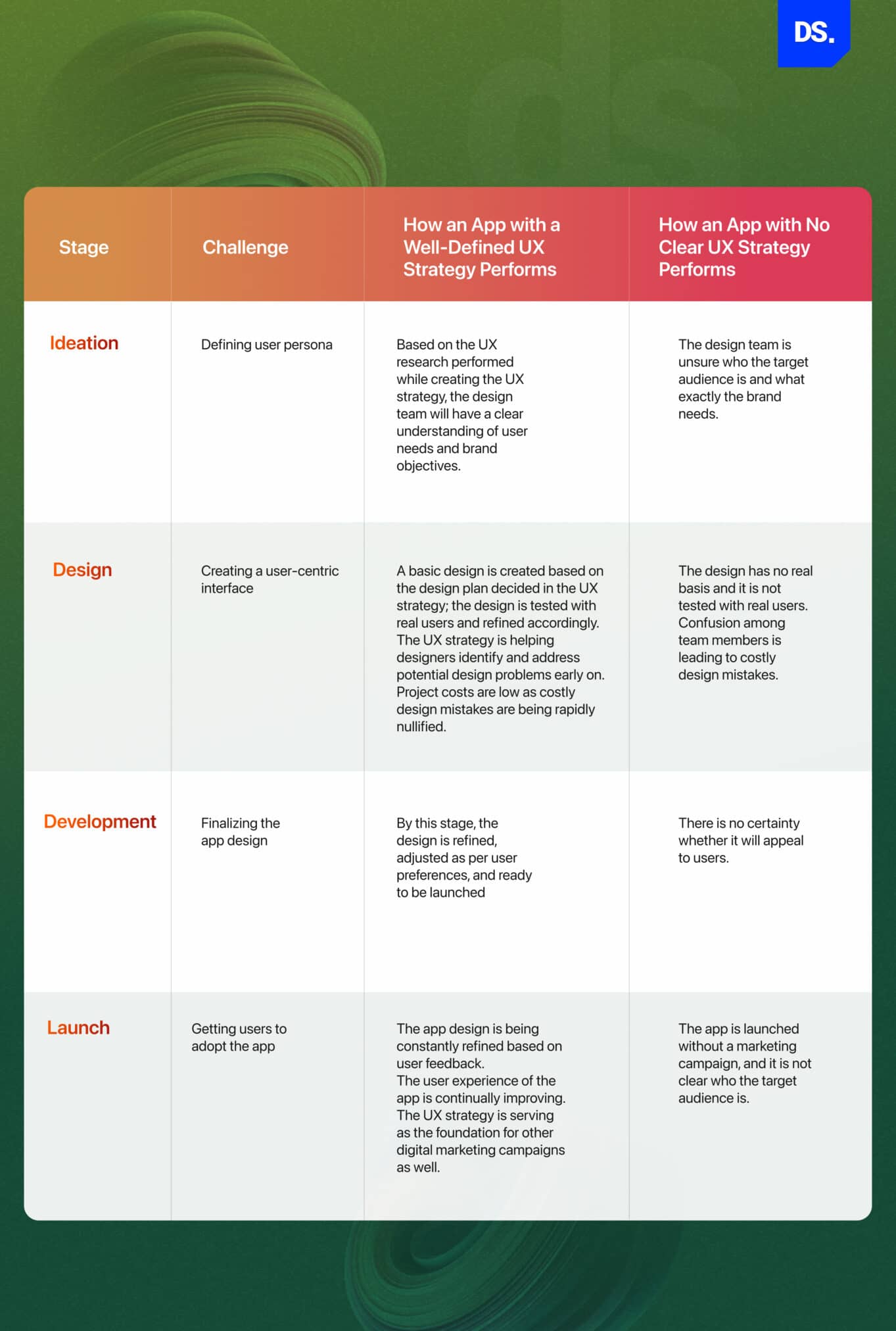
A well-defined UX strategy will be helpful even after your app/website has been launched. Here are some ways a strong UX strategy will improve the post-launch fate of your digital product:
Tracking Project Progress
A UX strategy creates clear performance goals from day one. These measurable data points let you track progress throughout the entire project, not just at completion.
A strong UX strategy will define what UX-related KPIs and metrics will be used to measure the progress of the project right from the start.
Hence, following the key objectives of the project and tracking project progress becomes much easier down the line.
Identifying Weaknesses
A UX strategy includes continuous research that reveals exactly where users struggle. It explains the weak areas/ friction points and their reasons behind their frustration.
This knowledge guides you to build the best features that boost customer loyalty and revenue. According to research, companies that do this consistently save 50% on rework costs since fixing usability issues after launch is far more expensive than catching them during designing period.
Updating the Strategy to Improve Outcomes
In most companies, design strategies are reviewed every quarter. You will analyze new user data to improve designs and keep them effective.
This data will keep your design team focused on solving the most pressing problems of your target users.
Who Is Responsible for UX Strategy?
UX strategy is owned by different people in different companies. As teams grow, the responsibility usually moves to dedicated design leaders or UX teams. It should always be a shared effort.
- Small/early stage startups: Here, the founder or product lead usually owns UX strategy with support from a senior product designer.
- Mid-sized/growth stage companies: For these types of organizations, generally a Head of Design, VP of Product, or UX Strategist guides the strategy with product and engineering teams.
- Large organizations: For large or enterprise teams, there will be a dedicated DesignOps or a UX team responsible for research, planning, and cross-team coordination tasks.
Good UX strategy comes from users, designers, developers, product teams, and business stakeholders working together.
Final Take
A UX strategy acts as a design roadmap that separates teams that ship products users love from teams that ship products users tolerate. It basically brings design, business goals, and user research into one shared direction to improve the overall product quality.
So, if you are creating digital products in 2026, developing strong UX strategies will be an all-important aspect of your job.
We recommend you invest a lot of time and thought into this process and take into account everything discussed in this article.
If you would rather have experts lead this process, partnering with the right design strategy firms can significantly accelerate the journey from vision to execution.
FAQs
What makes a good UX strategy?

A good UX strategy is built on user research, business strategy, product value, and a smooth user experience. These elements help create products that people enjoy using.
How do you measure UX strategy success?
To measure UX success, you need to track basic usability ( with task completion rate, error rate), business results (conversion rate, churn rate), and experience metrics (like NPS, CSAT, SUS score). Figuring out these measurements first guarantees your design updates are clearly tracked and proven.
Can small companies benefit from UX strategy?
Yes, a UX strategy acts as a master plan that can help small companies understand users, improve important features first, and make better product decisions without a large budget. This will also save extra rework costs and launch successful products sooner.