


SaaS UX Design Cost 2026: $5K–$150K by Funding Stage



SaaS UX design in 2026 can cost you somewhere between $5,000 to over $150,000. For a basic, lean MVP, the price can span between $5,000 and $20,000 to get off the ground. If you want to create a full end to end product being a seed-stage startup, you will need around $20,000 to $60,000.
Massive enterprise-level redesigns that require built-from-scratch design systems naturally scale up from $60,000 to $150,000 and beyond. If you prefer ongoing monthly support instead, a standard design retainer will generally cost you between $3,000 and $10,000 every month.
Ultimately, the biggest factor driving these prices up isn’t just the sheer amount of screens you need built. It actually comes down to how deeply the team has to research your audience, how many distinct user roles they have to account for, and whether they need to build a highly scalable design system.
If you are looking at drastically different price estimates for your SaaS design project – like $8,000 and another for $65,000? Both could be completely fair depending on what each agency is delivering. Our team handled more than 350 design projects, so we know this confusion well. This guide breaks it down for you.
For a deeper grounding in what good SaaS UX design looks like before budgeting, start with our complete SaaS UX Design Guide — the pillar resource this article is part of.
What Actually Determines SaaS UX Design Cost?
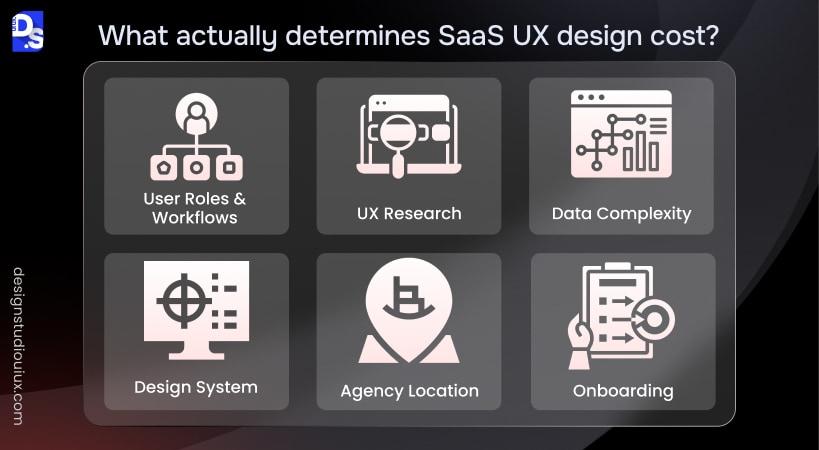
The price you pay for design work is not based on how attractive the interface is. It depends on the design choices of your team has to validate, and document before the development team can start writing code. Now, take a look at these major elements that shift that final number up or down.
- User roles and workflows: Before you start designing the product, brainstorm user roles and workflows. If you design a basic digital product which is meant for a single type of user – it is a whole different ballgame. This is different compared to building a SaaS platform that accommodates admins, managers, and standard users. Note that each of those groups will need a different navigation structure, permission levels, and personalized screens.
- UX Research: Next up is the overall depth of UX research required for the project. If you skip this critical research phase, this might let you save around $3,000 to $8,000 in the initial phase, but this will definitely cost your an extra $30,000 to $50,000 in redesign work.
- Dashboard and data complexity: Creating solid, role-based dashboards with all real time analytics data, filters, and customizable views is a difficult task. This is one of the absolute most expensive user experience problems to get right.
- Scope of the design system: Investing in a comprehensive design system – complete with design tokens, reusable components, states, and clear usage guides. It usually adds an extra $8,000 to $30,000 onto your initial budget. But if you decide to go without one, you will end up spending a lot more resources in the later stage.
- Agency location and seniority. US-based agencies charge $100–$250/hr. India-based agencies with global experience deliver comparable senior talent at $25–$75/hr — a 50–70% cost reduction with no quality trade-off when the agency has a proven international portfolio.
- Onboarding and activation scope. SaaS onboarding is where most products leak users — and fixing it is high-effort design work. Read our SaaS Onboarding UX guide to understand why this phase deserves its own budget line.
According to a Forbes research report, if you invest $1 in UX strategies, it will give you around $100. This makes SaaS UX one of the highest ROI items for the product team.
How much does a SaaS UX Design Project Cost at each Funding Stage?
Document your funding stages to get a complete idea of the project cost.
| Stage | Typical UX Design Scope | Estimated Cost Range | Average Timeline |
| Pre-seed / Bootstrapped | MVP UX design, core user flows, simple interface screens | $5k to $20k | Around 4–7 weeks |
| Seed Funding ($500K–$3M) | Complete UX- user research, onboarding, wireframes, polished UI handoff | $20k to $50k | Around 8–14 weeks |
| Series A ($3M–$15M) | Product redesign, scalable design system, developer documentation | $40k to $80k | Around 12–20 weeks |
| Growth Stage ($15M+) | Redesign work across different platforms – includes testing, advanced research operations | $60k to $120k | Around 16–28 weeks |
| Enterprise SaaS Platforms | Complex workflow overhaul, accessibility, enterprise design operations setup | $80k to $150k+ | 5 to 9 months |
| Monthly UX Retainer – any stage | Continuous UX updates, feature improvements, A/B testing support | $3k to $10k per month | Ongoing / Rolling |
The total design budget depends on your product features and user base. Designers must consider the risks of a bad user experience which can hurt the business.
These ranges reflect 2026 market rates. India-based agencies with US-client portfolios (like Design Studio UI/UX) typically deliver within the same quality tier at 40–60% lower cost than US-only agencies — a structural cost advantage, not a quality compromise.
Read: SaaS Design Principles that justify every budget line
Phase-by-phase Cost Breakdown
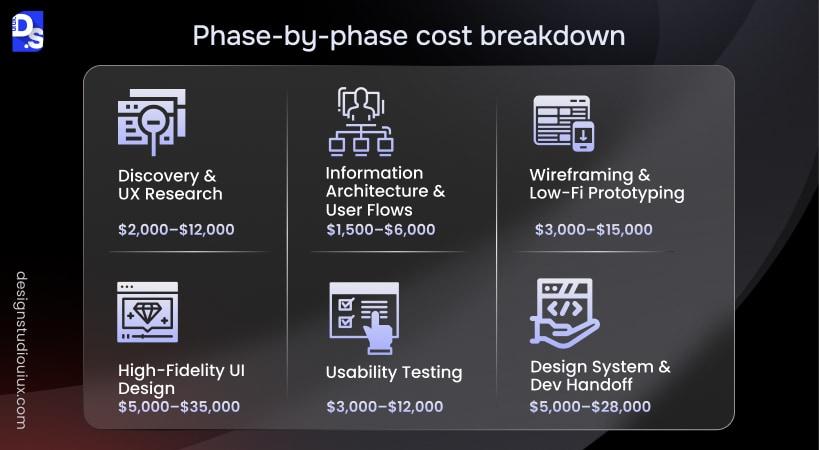
To complete a SaaS design project, follow a clear sequence of steps. Every step comes with its own specific set of deliverables and price tags. This helps plan the project accurately, figure out where you can safely trim costs if money gets tight, and make sure you include important steps.
| Stage | Work Included | Cost / Duration |
| Discovery and UX Research | User research, competitor review, usability audit, persona creation, JTBD mapping | $2k to $12k – around 1 to 3 weeks |
| Information Architecture & User Journeys | Website structure, navigation planning, detailed user flow diagrams | $1.5k–$6k- around 1- 2 weeks |
| Wireframes & Low-Fi Design | Simple layouts, screen structure planning, clickable prototype for testing | $3k to $15k – around 2 to 4 weeks |
| High-Fidelity UI Design | Pixel-perfect UI screens, responsive designs, branded visual elements, all states | $5k to $35k – around 3 to 8 weeks |
| Usability Testing & Validation | User testing sessions, prototype reviews, insights report, usability improvements | $3k to $12k – around 2 to 3 weeks |
| Design System & Handoff | Reusable components, design guidelines, developer annotations, QA support | $5k to $28k- around 3 to 6 weeks |
Common budget mistake- Rushing past the research phase to save money is a trap. Research by IBM shows that it is always 100 times cheaper to get the design right the first time.
How to Choose Best SaaS Design Pricing Model for Your Business?
- Project-Based (Fixed Price budget): You pay one set price for a specific list of tasks. This approach is considered a part of predictable spend and requires a proper design plan as well. This is the perfect fit for brand-new startups launching a fresh product. However, if you need to make changes mid project, this may cost you extra.
- Month-wise Charges: You pay for a set number of design hours every month. This concept works best for established organizations that need constant updates, UX improvements, A/B test design, and design system maintenance. You can expect to spend anywhere from $3,000 to $10,000 a month.
- Hourly Billing: You pay for the exact time spent working. It is flexible but very tough to predict your total costs. Senior agency designers run $100–$250/hr in the US. Useful for defined, bounded tasks. Not recommended for full product engagements where scope is uncertain.
Industry Trend: Exactly half of all design agency revenue comes from fixed project fees, while 44% comes from monthly retainers. Brand-new SaaS companies get the most value out of fixed projects, while scaling companies do better with retainers.
What Are The Hidden SaaS UX Costs Teams Often Miss
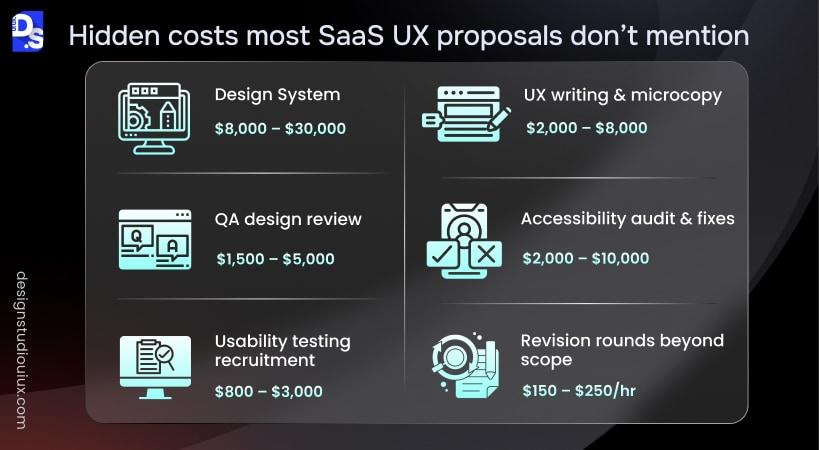
Most SaaS UX proposals only show the main design cost. But a real production-ready product usually needs extra work that gets added later. These costs are common, important, and often missed during early budgeting.
| Hidden Cost | Usual Cost Range | Why This Cost Matters |
| Design System Setup | $8k to $30k | Keeps future design features consistent and scalable |
| UX Writing & Microcopy | $2k to $8k | This can improve site navigation, forms, and onboarding process |
| QA Design Review | $1.5k to $5k | Reviewing built screens against designs before launch |
| Accessibility Testing & Fixes | $2k to $10k | Helps meet WCAG standards and enterprise requirements |
| Usability Testing Recruitment | $800 to $3k | Finds real users for testing product experience |
| Extra Revision Rounds | $150 to $250/hour | Additional design changes increase project cost quickly |
Related: UX Audit Checklist — catch usability issues before they cost you
Agency vs. Freelancer vs. In-house: Real Cost
| Hiring Option | Average Pricing | Good Choice For | Possible Downsides |
| Senior US Freelancer | $100–$175 per hour | Short projects with fixed requirements | No larger team support if project grows |
| US Design Agency | $150–$250 per hour or $25K–$150K per project | High-value products needing strategy and branding | Senior people often lead sales, not daily design work |
| India-Based UX Agency | $25–$75 per hour or $8K–$70K per project | Startups looking for experienced work at lower budgets | Different time zones need strong communication systems |
| In-House UX Designer | $108K–$145K yearly salary | Fast-moving teams shipping updates continuously | Extra employee costs increase total yearly spending |
Freelancers are not always the cheaper option. A senior freelancer charging $150/hour for 8 weeks can cost around $48k. An India-based agency charging $55/hour for 10 weeks may cost about $22k. This includes research, QA checks, and final developer handoff support.
Calculate ROI before Investing in SaaS UX Design: UX ROI Formula
Monthly revenue impact = (Current signups × Activation improvement %) × ARPU
Payback period = Design investment ÷ Monthly revenue impact
Example: You have 1,500 monthly signups. Onboarding activation rate is 24% — you want to reach 38%. ARPU is $59/month.
- More active users- (14% of 1500 = 210) means keeping 210 more users active every month.
- New monthly income- 210 users × $59 = an extra $12390 in revenue per month.
- Project investment: You spend $18k on the redesign.
- Payoff in Project Value- $18000 ÷ $12390 = 1.45 months. You clear the cost in under two months, and everything after that is pure profit.
That is not a UX cost — that is a 6-week investment that pays for itself every month in perpetuity. Improving onboarding is often the highest single-ROI design engagement a SaaS company can make. Read our complete guide on how to reduce SaaS churn and increase retention to see what drives activation and long-term retention together.
Note from Founder-
“The SaaS founders who get the best return from UX investment are the ones who arrive with a number — not ‘we want better design,’ but ‘our activation rate is 22% and our competitor’s is 47%. That gap is costing us $X per month.’ That framing turns UX from a cost centre into a growth lever.”
— Sneh Sagar, Co-Founder, Design Studio UI/UX (10 years · 350+ SaaS products)
Real Case Study: $18,000 Investment, Measurable Growth
REAL PROJECT · DESIGN STUDIO UI/UX
$18,000 UX engagement for a SaaS CRM platform — measurable retention impact
A healthcare-adjacent CRM platform (addiction treatment centers) came to Design Studio UI/UX after users were abandoning key workflows mid-task and churn was rising without a clear product reason. A UX audit identified 14 critical friction points — most concentrated in the case management flow and reporting module. The engagement covered research, audit, full redesign of the 3 core workflows, usability testing with 8 users, and developer handoff.
- $18K- Total investment
- −41%- Task abandonment rate
- +34%- Feature adoption (90-day)
- 6 wks- Delivery timeline
5 Red Flags in a SaaS UX Design Proposal
After reviewing hundreds of proposals for clients and receiving them ourselves, these five patterns consistently predict a problematic engagement.
Quoted by number of screens, not complexity.
“30 screens for $12,000” tells you nothing. A dashboard with 6 screens can be 5× the work of a 30-screen marketing site. A quote without a scope document is a guess, not a proposal.
No discovery or research phase included.
An agency willing to start designing immediately — without understanding your users or your current analytics — is optimising for delivery speed, not for outcomes.
Design system not mentioned.
If the proposal includes UI design but no mention of a component library or handoff documentation, ask explicitly. What you receive will be one-time screens, not a scalable foundation.
Senior designers on the pitch, junior team on the project.
Ask who will be working on your product day-to-day. Many agencies present senior leadership in proposals and assign mid or junior designers to execution.
No mention of conversion or activation metrics.
Good SaaS UX agencies talk about measurable outcomes from the first conversation. If the proposal only discusses aesthetics and deliverables — never user behaviour, activation, or retention — that is the agency’s ceiling.
When You should NOT Invest in Full SaaS UX Design (yet)
This is the question no agency will answer honestly, but it matters.
Do not buy a full redesign if you are not sure people want your product. Before you spend your resources on design aesthetics, invest $5k to $10k on research and rough prototypes. This will help validate your product ideas, i.e. verify the product market fit of the design concepts.
Do not build a complicated design system without at least 3 frontend developers since the system is meant to help multiple coders work together. If you have a lower budget, invest in a well organized Figma file for basic design work.
Always prioritize usability issues over aesthetics of the website. If the site workflow is broken, it is recommended to invest in a UX audit and find friction points.
FAQ’s About UI/UX Design Cost for SaaS
How much does SaaS UX design cost in 2026?

A SaaS UX design can cost you somewhere between $5k to over $150k. For a basic, lean MVP, the price range lies between $5k and $20k. For an end to end product being a seed-stage startup, you will need around $20k to $60k.
What factors most affect SaaS UX design cost?
The final SaaS design cost depends on the number of user roles, depth of user research and testing, and dashboard complexity. Also, the design charges changes with agency location and seniority. For example, if you hire a US agency it can cost you around $100–$250/hr and an overseas team can cost at $25–$75/hr.
Is it cheaper to hire a freelancer or a UX design agency for a SaaS product?
Hiring a freelancer for design work can be cheaper upfront. But, in the long run, this can cost you more for end to end product design. On the other hand, a UX design agency always provides an outline of their fee structure per project with multidisciplinary team support to build scalable SaaS products.
What is included in a SaaS UX design project?
Design projects usually try to keep customers engaged with the digital product and increase the overall adoption of the product features. They focus on user research, IA, wireframing, interactive prototyping, and QA checks. This includes real-world user testing, and a fully documented handoff for your developers.
How long does SaaS UX design take?
The duration of a SaaS UX design project totally depends on clients’ requirements. A simple MVP usually takes 4 to 8 weeks and a complete product design takes 10 to 16 weeks. On the other hand, a major corporate redesign can last anywhere from 5 to 9 months.
What is a SaaS UX design retainer and how much does it cost?
Design retainer is a ongoing monthly fee of a SaaS design project where you will pay a fixed fee to a design agency or freelancer. The fee amount depends on the project requirements and usually lies in the range between $3,000 and $10,000. The amount can go higher- depending on the complexity of design work.
When is the right time to invest in SaaS UX design?
The best time to invest in an effective SaaS UX design is when building your MVP to understand the product-market fit. You can also spend on a good design if your user churn spikes or conversions drop. But waiting to fix UX problems is always more expensive than building it well from the start.