


UX Audit Cost 2026: $3K–$25K & When It Pays Off



from our UX Audit Guide

Quick Summary
A UX audit can cost you somewhere between $3,000 – $25,000 in 2026. A focused flow audit covering one user journey runs $3,000 – $6,000. A full product audit with heuristic review, session analysis, and real user testing costs $8,000 – $18,000. Enterprise audits cost $18,000 – $25,000+. The biggest cost driver is not the agency’s size, it’s the number of user roles in your product and whether live user testing is included in the scope.
UX audit pricing can feel confusing on purpose. One agency can give you an estimated quotation of $2,000 while another asks for $20,000 for the exact same request. You must know that both of these agencies use the same name, but the actual work is completely different.
This article breaks down the actual cost drivers of a UX audit project, explains what you receive at different budgets and details about the hidden fees. This will help you determine if an audit is worth the investment.
If you need the operational steps of an audit, you can slide through our guide on how to conduct a UX audit.
According to a Forrester research, if you invest $1 in UX, it can bring back up to $100. That statistic shows why analyzing these UX related costs is worth your time.
How much does a UX audit cost in 2026?
The UX audit cost depends on the complexity of the digital product. Below is the market breakdown based on real proposal data across SaaS, mobile, and web products:
| Audit type | Who typically does it | Price range | Timeline |
| Heuristic review only | Junior freelancer | $500 to $2,000 | 3–5 days |
| Focused flow audit | Senior freelancer / boutique agency | $3,000 to $6,000 | 1–2 weeks |
| Full product audit | UX design agency | $8,000 to $18,000 | 2–4 weeks |
| Enterprise UX audit | Specialist agency | $18,000 to $25,000+ | 4–8 weeks |
| AI audit tool | Software (Hotjar, Krux) | $9 to $30/month | Same day |
The $500 heuristic review exists. For products with fewer than 5 screens and a simple user journey, it gives you a sanity check. For anything more complex – multiple user roles, onboarding sequences, dashboard-heavy flows – it is not enough to make confident product decisions.
The most common waste in this market is not the $20,000 audit. It is the $3,000 audit bought for a $15,000 problem.
What actually determines UX audit cost?
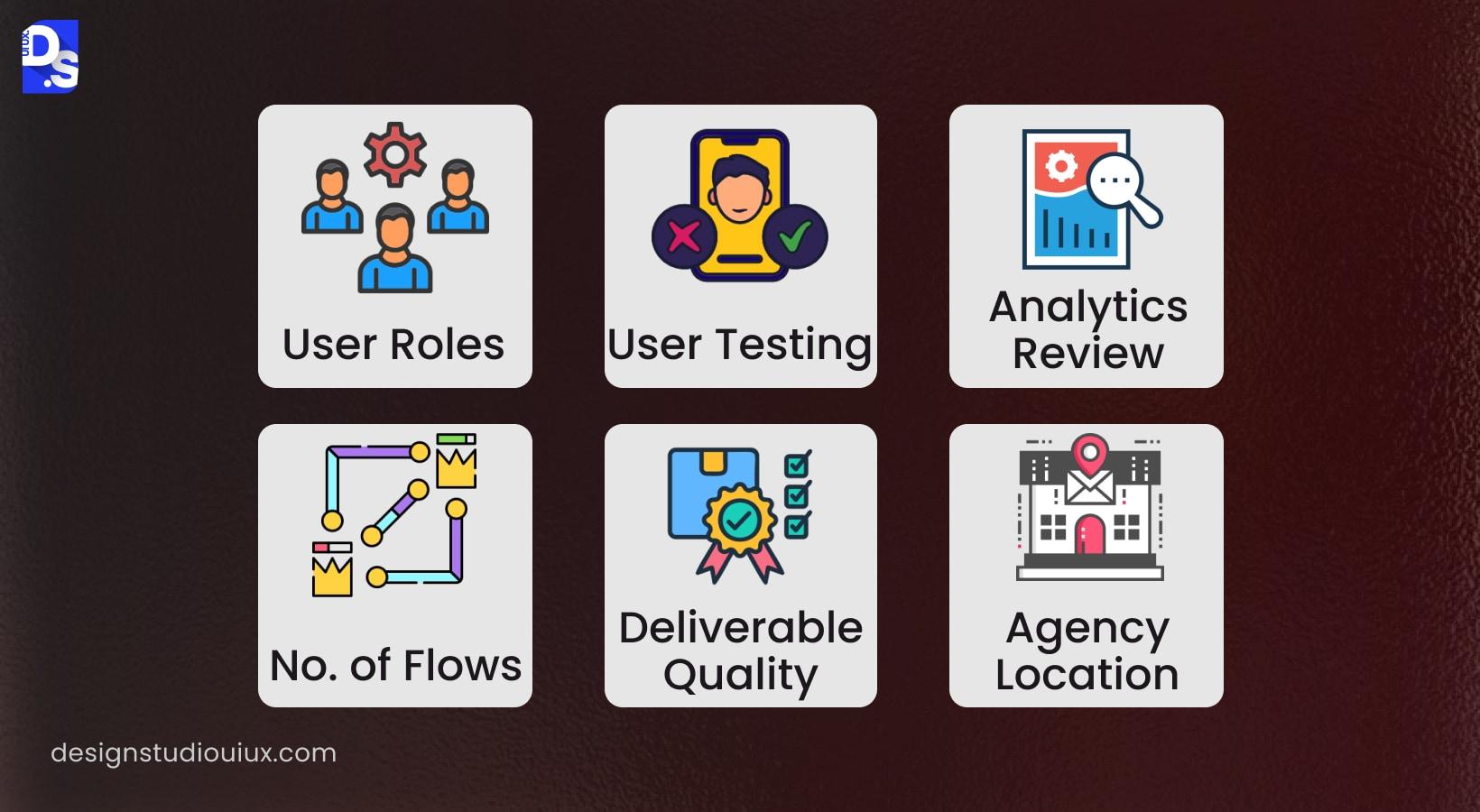
Six things move the price more than anything else.
1. Number of user roles
A product with one user type is one audit. A B2B SaaS CRM with case managers, supervisors, and admins — each with different navigation, permissions, and workflows — is three separate scopes. Each additional user role adds roughly 30–50% to audit time.
2. Whether real user testing is included
Heuristic evaluation – an expert reviewing your screens against Jakob Nielsen’s 10 usability heuristics – costs less than moderated user testing where 5–8 real users complete tasks while a researcher observes. User testing adds $2,000–$6,000 to an audit. It also catches issues expert review misses entirely. Patterns obvious to a designer are genuinely invisible until you watch a real user struggle with them.
Ask any agency directly: does your quote include live user testing or just expert heuristic review? That single question tells you what you are actually buying.
3. Depth of analytics review
Reviewing Hotjar session recordings, Mixpanel funnels, and FullStory rage clicks takes 8–15 hours on its own. Some audits include this. Many skip it. Without analytics data, you get expert opinion — not evidence. Our guide on best UX audit tools covers which tools work best at each stage of the audit process.
4. Product complexity and number of flows
A product with a signup page and one dashboard is a fundamentally different audit from a product with onboarding, multi-step workflows, role-based dashboards, billing, and settings. The complexity difference is not cosmetic – it is 4–6× the audit time and scope.
5. Deliverable quality
There is a huge difference between a static list of mistakes (PDF) and a complete UX evaluation featuring visual blueprints to fix them, a guide on what to tackle first, and a live walk-through with your staff. The second version costs more. It is also what your engineering team can act on in a sprint. A 50-page PDF in Slack is not an audit deliverable – it is a risk to the investment.
6. Agency location
A US-based agency charges $100–$250/hour. An India-based agency with a proven global SaaS portfolio charges $25–$75/hour for the same senior-level work. On a 4-week full product audit, that difference is $8,000–$18,000 in total cost. It is not a quality difference – it is a geography difference.
UX audit cost by scope – 3 tiers explained
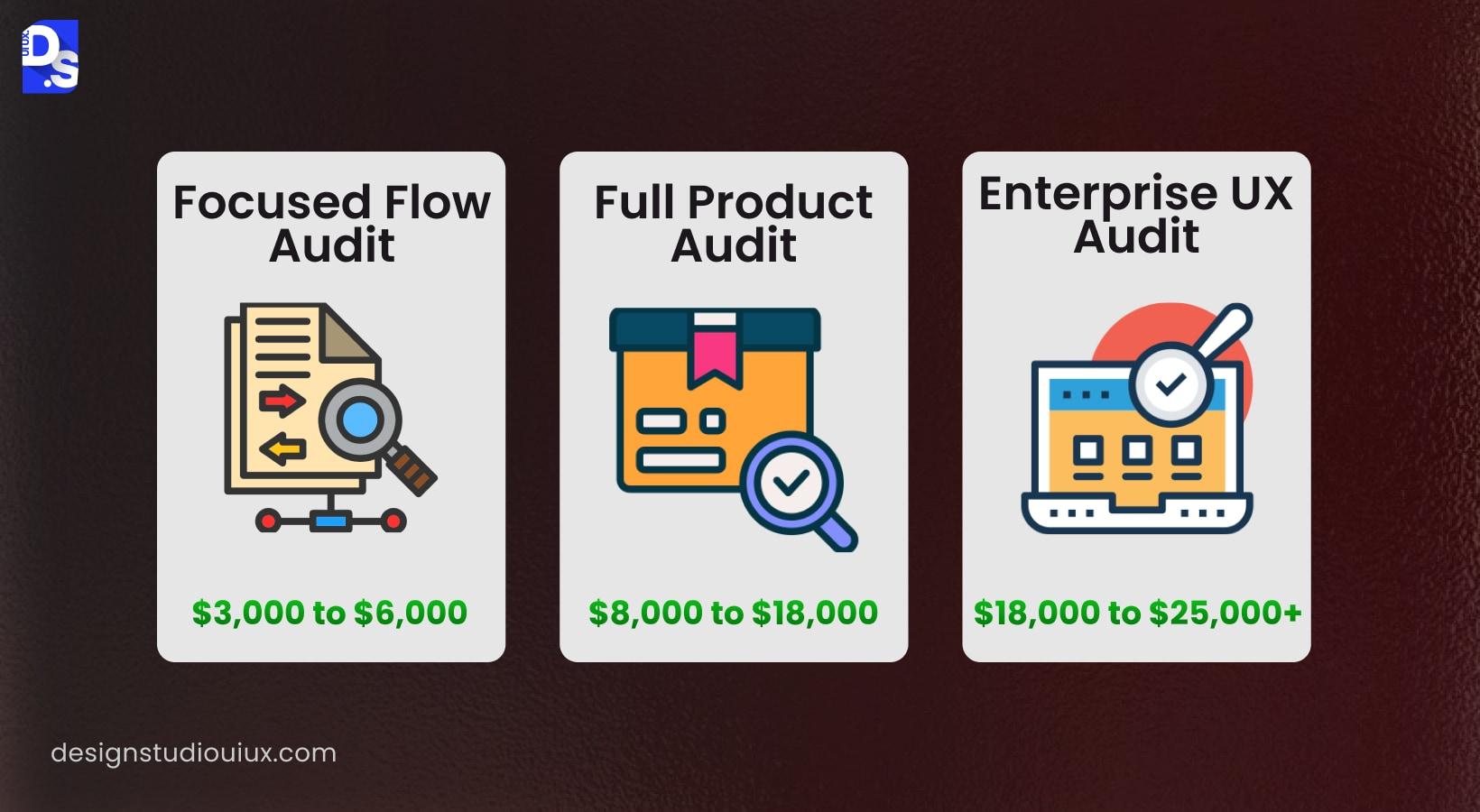
Tier 1: Focused flow audit ($3k to $6k)
This tier covers a complete user journey, such as your onboarding sequence, signup/checkout page, or a conversion problem.
- What you get: You can expect a heuristic evaluation of the chosen flow, detailed annotations, a prioritized issues report, and a 90 minute walk-through call. The best audits at this price point also include a basic review of around 10 to 20 user session recordings.
- When to choose it: You should go for this section if you have one particular underperforming area and you need a fast, accurate fix for this issue. It is basically ideal for pre-Series A startups, products with under 2k monthly active users (MAU), or teams facing an urgent launch deadline.
- When to skip it: If you are not completely sure where your users are getting stuck, then you must ignore it as it will not be a good investment. You should opt for a full product audit instead
Tier 2: Full product audit ($8k to $18k)
This covers all primary user flows across the product where you need to take care of onboarding, core workflow, dashboard, settings, and account management (for a SaaS product).
- What you get: You can expect a complete heuristic review, an in-depth analysis of around 20 to 40 Hotjar or FullStory session recordings and maps showing exactly where users drop off. Also, there are 5 to 8 live user testing sessions, annotated wireframes for important problems, effort-versus-impact priority matrix, and a full team readout/ppt.
- Right for you if: Let’s say, you have 1k to 50k MAU, churn you cannot explain through support tickets alone, or you are planning a redesign and want to know what is genuinely broken before you build. The relationship between UX decisions and churn is direct — our guide on reducing SaaS churn through UX design covers the specific design patterns that move retention numbers.
Tier 3: Enterprise UX audit ($18k to $25K+)
This tier includes complete product coverage while evaluating every user role individually.
- What you get: Here, you will find a full product review together with strict accessibility testing under WCAG 2.2 standards (the current standard for digital accessibility). Also get competitive benchmarking against 3 to 5 rival products, key stakeholder interviews, and an executive roadmap plan with phased recommendations.
- When you can choose it: This tier is perfect for companies at Series B or beyond that manage more than 5 user personas or operate under strict healthcare or fintech compliance laws. It works great for teams wanting a risk-free, data-backed plan before funding major system changes.
Compare Freelancer vs. agency vs. In-House Cost
| Option | Typical cost | Best for | Watch for |
| Senior freelancer | $3,000–$8,000 | Focused audits with a clearly defined scope | No team depth. You own the ‘what next’ problem. Quality varies wildly by individual. |
| India-based agency (global portfolio) | $5,000–$18,000 | Full product audits at 40–60% lower cost than US firms | Choose agencies with proven international SaaS work. Async-first process matters for timezone overlap. |
| US-based agency | $10,000–$25,000+ | Complex enterprise audits with large stakeholder groups | Senior talent on the pitch, junior team executing. Ask specifically who runs your audit. |
| In-house UX team | $0 direct cost, but… | Continuous audit as part of regular product rhythm | Familiarity bias is real. Designers who built the product stop seeing what new users see. |
One thing worth saying directly: the familiarity problem is not a skill problem. The best UX designers in the world stop noticing issues in products they built. An external audit is not a luxury – it is the point.
UX audit cost by product type – what you will typically pay
| Product type | Typical range | What drives cost up |
| B2B SaaS | $5,000–$20,000 | Different types of user roles and workflows, complicated SaaS dashboards, role-based permissions |
| Mobile app | $4,000–$15,000 | Device fragmentation, gesture-based navigation, offline states, push notification UX |
| E-commerce | $3,500–$12,000 | Cart and checkout complexity, product filtering, multi-device purchase flow |
| Web app (complex) | $8,000–$25,000 | Data visualization, multi-step form flows, role-based permissions, complex navigation |
The most expensive products to audit are dashboard-heavy B2B platforms. Complex data visualization and multi-role navigation add significantly to audit scope. Our guide on SaaS dashboard design explains why dashboard UX is the most technically demanding layer to evaluate — and why most basic reviews miss critical issues here.
5 Signs Your SaaS Needs a UX Audit Right Now
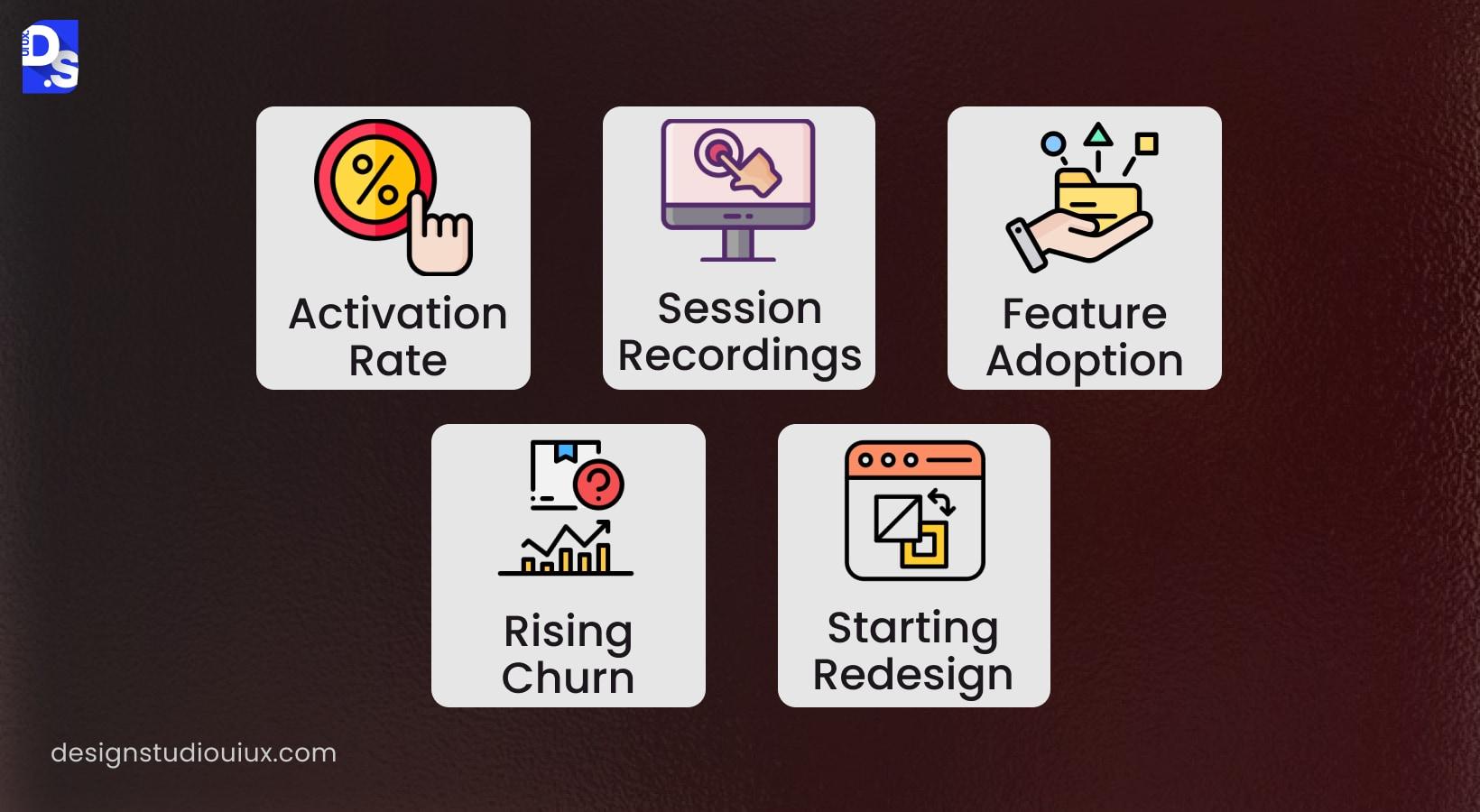
You do not need to wait for a product crisis. These five patterns are specific and measurable:
1. Your activation rate is below the industry average
According to Userpilot’s data, around 36-37% of new SaaS users actually complete onboarding successfully. If you convert less than 30-40% of them, your setup process has a glitch that a $3k to $5k review will uncover.
Context: Amplitude’s 2025 Product Benchmark Report, drawn from more than 2,600 companies, found that over 98% of new users churn within two weeks when they never reach a meaningful value milestone. Activation is not a onboarding metric – it is a retention metric.
Our guide on SaaS onboarding UX covers the specific patterns that move activation rates – and the ones that consistently kill them.
2. Session recordings show rage clicks
If Hotjar or FullStory is showing repeated clicking in areas that are not interactive, users are confused by the interface. They expect something to respond that does not. This is fixable once identified – but completely invisible without session recording data.
3. Feature adoption is below 20% after 30 days
If users signed up and are not using a core feature after a month, they either do not know it exists or cannot find it. Both are UX problems, not product problems. The fix is almost always information architecture or onboarding design – not more features.
4. Churn is rising without a clear product reason
If retention is dropping and your support tickets are not pointing to a specific bug or gap, the problem is friction – users hitting walls they do not report. They just leave. A UX audit finds those walls.
Data (Frederick Reichheld of Bain & Company research) shows that if you can retain around 5% more clients, you can raise SaaS profits by 25% to 95%. Because B2B SaaS companies lose around 3.5% of users monthly, even a 1-2% fix to user experience can result in big profit numbers.
5. You are starting a redesign
The worst mistake in redesigning a digital product is redoing good parts and leaving broken ones alone. A UX review spots these hidden problems so you actually improve how things work, instead of just making the site look pretty.
What is actually included in a UX audit?
This is where most proposals are vague. Ask for this list explicitly before agreeing to anything.
- Heuristic evaluation – expert review against Jakob Nielsen’s 10 usability heuristics applied screen by screen. Originally developed by Nielsen and Rolf Molich in 1990 and still the industry standard for UI review.
- User flow mapping – entire user journey from signup to core value, while documenting and counting where users abandon the process.
- Session recording review – minimum 20–30 user sessions across core flows using Hotjar, FullStory, or Microsoft Clarity. This is where rage clicks and confusion patterns become visible and you can tell where people are struggling.
- Analytics funnel analysis – where exactly do users drop off, at what percentage, and at which step using Mixpanel or GA4
- User testing – 5 to 8 participants completing defined tasks. Moderated finds richer insight; unmoderated is faster and cheaper. Either is better than none
- Findings report – every issue documented with: severity rating, screenshot, what causes the problem, and a specific recommended fix, not just a list of complaints
- Effort × impact prioritization matrix – issues ranked by difficulty to fix versus impact on user experience. This is what your PM needs to put findings into a sprint
- Team readout session – a live walkthrough with your product and engineering team. A PDF in Slack is not a readout
- Implementation guidance – specific direction, not vague recommendations
For a step-by-step framework on what a complete audit process looks like, see our UX audit checklist.
What happens after the audit and what implementation costs
The audit is the diagnosis. Implementation is the treatment. Budget for both.
| Fix type | What it covers | Typical budget |
| Quick wins | Copy changes, button labels, error messages, tooltip additions | Developer time only – usually $0–$1,000 |
| UX improvements | Signup flow restructure, onboarding redesign, navigation improvements | $3,000–$12,000 design + development depending on scope |
| Structural redesign | Information architecture overhaul, core workflow redesign | $15,000–$50,000+. Full cost context: see our SaaS UX design cost guide |
One thing that catches teams off guard: post-audit support hours. Ask before signing whether implementation support is included – answering developer questions, reviewing built screens against findings. Many agencies do not include this. It is worth the extra cost.
Full context on what comes after an audit, including end-to-end redesign costs, is in our SaaS UX design cost guide.
How to calculate ROI before booking a UX audit
You can follow these following steps to calculate ROI
Step 1: Find your biggest UX-related leak
Open analytics, check your data for the biggest step where users abandon your product. Is it during onboarding, using features, or buying?
To put a number on it, let’s say 1.2K users sign up but 32% finish, that means 816 potential buyers are slipping away or deactivating their purchasing/subscription every month.
Step 2: Calculate monthly cost of that UX issue
Improving activation from 32% to 50% means 216 additional activated users per month, then it implies extra MRR. Also, let’s say your monthly ARPU is $75, that is $16,200 additional MRR. Every month the problem is not fixed, it can cost you $16,200 in potential revenue.
Step 3: Compare the audit cost to the cost of inaction
A $12,000 full product audit that finds and fixes the onboarding problem has a payback period under one month. After that, every month the improvement runs, you are $16,200 ahead.
Bain & Company data shows that retention improves company profits. For example, on a $60k MRR with an 8% churn rate. This saves around 3% of those users securing roughly $18k over half a year, meaning a $12k churn audit quickly recoups its cost.
According to Forrester, organisations investing in UX see revenue retention improve by up to 10.8% over three years – separate from the headline $1-in, $100-out figure, this sustained retention lift compounds with every passing year a UX investment is in place.
Real Case Study: What an $18,000 UX Audit Delivered
REAL PROJECT · DESIGN STUDIO UI/UX
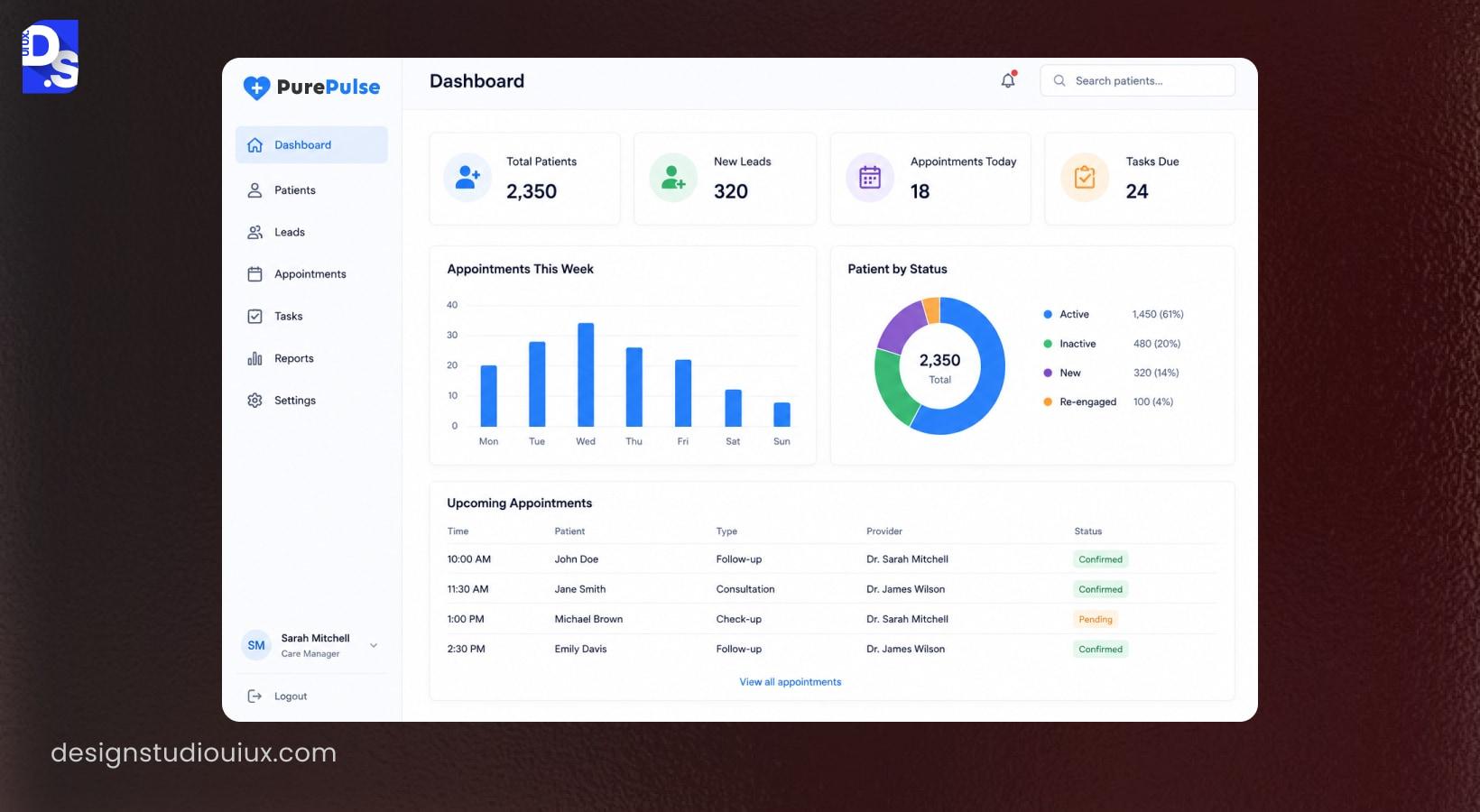
Healthcare CRM platform – SaaS audit across 3 user roles
A healthcare-adjacent CRM platform serving addiction treatment centers came to us with rising task abandonment, increasing support tickets, and churn going up quarter-on-quarter. Internal copy updates and in-app tooltips had not moved any metric.
Audit scope:
- Full heuristic review across 3 user roles: case managers, supervisors, admins
- 28 session recording reviews in FullStory across the case management flow
- Mixpanel funnel analysis across 4 core workflows
- 6 moderated user testing sessions with actual case managers
- Findings report: 22 documented issues with severity, screenshot, and recommended fix for each
- Annotated wireframes for the 6 highest-priority fixes
- Full team readout + implementation guidance session
What it found:
14 critical friction points, most concentrated in the case management flow. The core issue: a 9-step data entry sequence required case managers to work in a sequence that did not match how they thought about their work. They were fighting the software to do their jobs. This pattern was invisible in the analytics — it appeared as abandonment, not as a workflow sequence problem.
Audit cost: $18,000. Delivered in 5 weeks.
Results – 90 days after implementation:
- $18K in total audit cost
- – 41% task abandonment
- +34% feature adoption
- – 28% support tickets
Total investment including implementation: approximately $38k. Retained MRR impact within 90 days: estimated $15k+. The audit paid for itself in the first month.
When is a UX audit not worth the cost?
- Under 200 monthly active users. At this stage you do not have enough session data to validate findings. Spend the money on user interviews and prototype testing instead.
- Product-market fit not confirmed. If users are churning because they do not want the product — not because they cannot use it — a UX audit will not help. Get on calls with churned users first and ask why they left.
- Buying a cheap audit for a complex product. A $1,500 freelancer heuristic review of a 6-role enterprise SaaS is not a UX audit. It is a cursory opinion. When the product has real complexity, underspending produces findings too shallow to act on confidently.
- Auditing everything when you have one specific problem. If you already know through analytics that a specific flow is broken, a $3,000–$5,000 focused audit is the right scope. A full $15,000 product audit on a locatable problem is inefficient use of budget.
FAQs
How much does a UX audit cost?

A UX audit typically costs $3k – $25k or more – which depends on the design requirements of your site or app. A thorough website review with usability checks, session tracking, and user feedback costs around $8K to $18k and enterprise-level design work can cost $18k to $25k.
How long does a UX audit take?
A focused flow audit takes 1–2 weeks. A full product audit takes 2–4 weeks. Enterprise audits take 4–8 weeks. Timeline depends on scope, number of user roles, and whether moderated user testing is included.
What is actually included in a UX audit?
A proper audit includes heuristic evaluation against Nielsen’s 10 usability principles, user flow mapping, and session recording review (20 to 40 recordings). The audit also includes analytics funnel analysis, user testing (5–8 participants), a prioritized findings report with recommendations, and a team readout.
Is a UX audit worth the cost?
Yes, a UX audit is definitely worth the cost when you want to manage activation or retention problems of your digital product. A well-executed UX audit increases conversion rates by 30–40% by addressing all usability issues. It reduces costly development rework and ultimately improves adoption rate and brand revenue.
What is the difference between a UX audit and a usability test?
A UX audit is a professional review of product design. Basically it analyzes design principles and analytics to find issues related to usability, visual design, and workflow. Usability testing is a component of audit which explains how users navigate the product to see where they get confused.
Can I do a UX Audit in-house?
Yes, you can conduct a UX audit in-house. It is a fast and cost effective way to know usability issues. However, internal teams often suffer from familiarity bias, so if you are worried about conversion or churn, you can consider an external review as well.
How much does it cost to implement UX audit findings?
Implementing UX audit can generally cost between $3,000–$12,000 if you are redesigning a broken website flow. If you have to make several changes in the website interface, the cost can go somewhere between $15K to $50K depending on the nature of the product.
How often should you do a UX audit?
For most SaaS products, every 18–24 months or after any major product update or user base expansion. Focused flow audits on high-traffic critical paths can be done every 6–9 months. Before a fundraise – where product polish signals execution quality to investors- is also a high-value trigger.