


Outsourcing UX Design in 2026: Rates, Models and Red Flags


Quick summary
- To outsource UX design means hiring an external agency, freelancer or dedicated team to handle user research, UX and UI design instead of building an in-house team.
- Agency rates in 2026 range from about $100–$149 per hour in the US to $25–$49 per hour in India, Ukraine, Mexico and the Philippines, according to Clutch.
- A US in-house UX designer costs more than the salary suggests: a median pay of $104,000 becomes roughly $149,000 a year once benefits are added.
- Choose the engagement model by scope: fixed price for defined projects, a dedicated designer for ongoing product work.
- Protect your intellectual property with an explicit copyright assignment clause. A “work for hire” line alone often does not cover UI/UX work.
Companies outsource UX design to get senior design skills faster and at lower cost than hiring in-house. The decision comes down to three questions: what the work costs in each region, which engagement model fits your product stage, and how to keep quality and ownership under control. This guide answers all three with 2026 figures.
What does it mean to outsource UX design?
Outsourcing UX design means contracting an outside partner to plan and design how people use your product. Here, the partner can be an agency, a freelancer or a dedicated designer who works inside your team. The project scope can cover user research, information architecture, wireframes, UI design, prototypes, usability testing and design systems.
Most companies choose user experience outsourcing for one of three reasons:
- Speed: an agency can usually start within one to two weeks, while hiring a senior designer can take months.
- Skill range: one partner can supply researchers, UX designers and UI designers, which a single hire cannot.
- Cost control: you pay for the hours or scope you need, without salary, benefits or recruiting costs.
How much does it cost to outsource UX design in 2026?
Outsourced UX design costs between $25 and $149 per hour in 2026, depending mainly on where the team is based. US and Canadian agencies sit at the top of that range, while agencies in India, Ukraine, Mexico and the Philippines sit at the bottom. Project budgets most often fall between $10,000 and $49,999.
UX design rates by region
| Region (example countries) | Typical agency rate per hour | Time difference from US Eastern |
|---|---|---|
| North America (US, Canada) | $100–$149 | 0–3 hours |
| UK and Western Europe (UK, Spain) | $50–$99 | 5–6 hours ahead |
| Eastern Europe (Poland) | $50–$99 | 6 hours ahead |
| Eastern Europe (Ukraine) | $25–$49 | 7 hours ahead |
| Latin America (Mexico) | $25–$49 | 0–2 hours behind |
| South Asia (India) | $25–$49 | 9.5–10.5 hours ahead |
| Southeast Asia (Philippines) | $25–$49 | 12–13 hours ahead |
Source: Clutch UX/UI design pricing data, based on verified client reviews, 2026. Time differences vary with daylight saving.
Freelancers follow a different pattern. Freelance UX designers report a median rate of $80 per hour, with the middle half of rates between $50 and $111 (contractrates.fyi, March 2026). A freelancer is usually one person covering the work, without separate research, project management or design review behind them.
For a breakdown by project type, our guide to UI/UX design project costs covers audits, MVPs and full redesigns.
What a dedicated designer costs per month
A full-time dedicated designer works about 160 hours a month. Applying the Clutch rate ranges to 160 hours gives these monthly costs:
| Location of the agency | Monthly cost for one dedicated designer |
|---|---|
| US or Canada | $16,000–$23,840 |
| Poland, UK or Western Europe | $8,000–$15,840 |
| India, Ukraine, Mexico or the Philippines | $4,000–$7,840 |
At Design Studio UI/UX, a dedicated designer for US clients costs $4,500 – $6,000 a month, depending on the scope of work and the designer’s experience level.
How outsourcing compares with an in-house hire
The median annual pay for US web and digital interface designers was $104,000 in May 2025, according to the US Bureau of Labor Statistics. Salary is only part of the cost. In private industry, wages make up 70% of employer compensation costs, and benefits make up the remaining 30% (BLS, June 2026).
Applying that ratio, a designer paid $104,000 costs an employer roughly $149,000 a year, before recruiting fees, equipment and software. That is about $12,400 a month for one person with one skill set. An offshore agency can often supply a designer plus research and review support for less.
Which engagement model should you choose?
Choose the engagement model by how well defined your scope is. A fixed-price project works when the deliverables are clear, and time and materials work when the scope will change. A dedicated designer or team works when design is ongoing product work rather than a one-off project.
| Model | How you pay | Best for | Watch out for |
|---|---|---|---|
| Fixed-price project | One agreed price for a defined scope | Redesigns, MVP design, UX audits | Change requests cost extra, so the scope must be written in detail |
| Time and materials | Hourly or daily rate for hours worked | Discovery, research, evolving products | Needs a budget cap and weekly hour reports |
| Dedicated designer or team | Monthly fee for full-time capacity | SaaS products shipping every sprint | Needs your product owner’s time each week |
| Staff augmentation | Monthly fee; the designer works inside your process | Teams with a design lead but no capacity | You manage the designer day to day |
| Design subscription | Flat monthly fee for a queue of requests | Marketing pages and small UI tasks | Rarely includes user research or strategy |
In our work with SaaS clients, many start with a short fixed-price phase, such as discovery or a UX audit. They move to a dedicated designer once the roadmap is clear. A first phase lets both sides test the working relationship before a monthly contract. If an audit is your first step, here is what a UX audit costs.
Is it better to outsource UX design or hire in-house?
Outsourcing is better when you need to start quickly, need several design skills, or cannot keep a full-time designer busy. Hiring in-house is better when design is a daily, core part of your product and you can afford a senior hire who will stay for years.
Outsource when:
- You are building an MVP or redesigning a product and need results in weeks.
- You need research, UX and UI skills together.
- Design work comes in phases rather than every day.
- You want to test a design partner before building an internal team.
Hire in-house when:
- Design decisions happen daily and need deep product knowledge.
- You are building a large design system that needs a long-term owner.
- Regulations or security rules limit who can access your product data.
Many companies combine both: an in-house design lead who sets direction and an outsourced UX team that adds capacity.
How do you outsource UX design successfully?
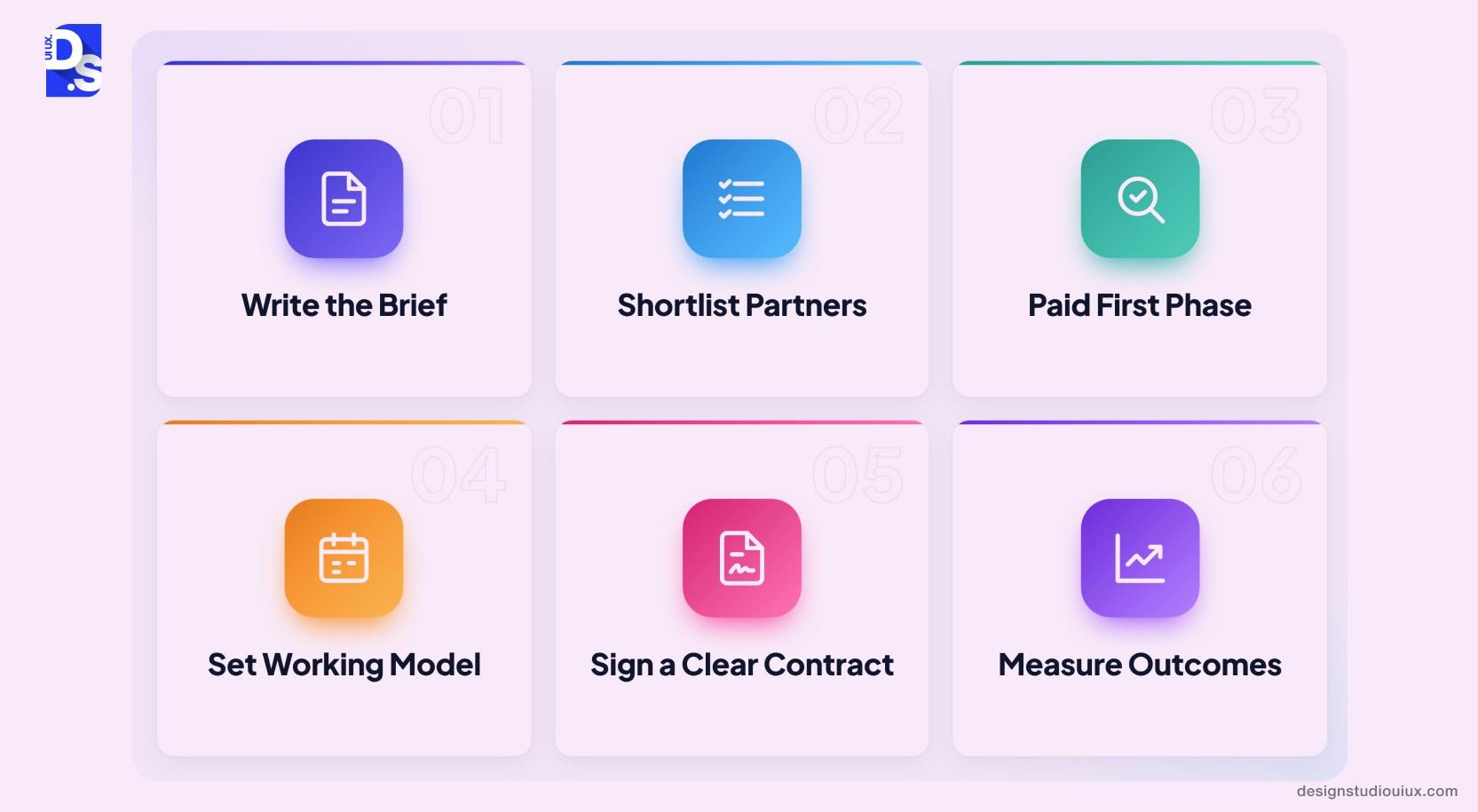
Successful UX outsourcing depends on preparation before the contract and a fixed working rhythm after it. These six steps cover both.
- Write a one-page brief. Include the business goal, target users, the problem to solve, deliverables, deadline and budget range.
- Shortlist three to five partners. Check portfolios for products like yours and read verified reviews on Clutch or G2. A checklist for choosing a UI/UX design agency helps here.
- Start with a paid first phase. A discovery phase or UX audit of two to four weeks shows how a partner thinks before you commit to more.
- Agree on the working model. Set shared hours, the main communication channel, weekly reviews and who approves designs.
- Sign a clear contract. Cover scope, payment milestones, copyright assignment, confidentiality, source file handover and termination.
- Measure outcomes, not just deliverables. Agree on two or three metrics, such as task success rate, onboarding completion or conversion rate.
How do you protect your design IP when outsourcing?
Protect your design IP with a written clause that assigns all copyright in the work to your company, signed by both parties. A “work made for hire” line alone is often not enough for UI/UX work.
Under US copyright law, a contractor’s work only counts as work made for hire if it fits one of nine specific categories. Both parties must also sign a written agreement that says so. The categories include translations, compilations and audiovisual works. App screens and website designs often do not fit them, so an explicit copyright assignment is the safer route.
Your contract should also cover:
- Source files: ownership of Figma files, prototypes and design system libraries, stored in an account your company controls.
- Confidentiality: an NDA that covers user research data and product plans.
- Third-party assets: licenses for fonts, icons and stock images transferred to your company.
- Portfolio use: whether the partner may show your project publicly, and when.
This section is general information, not legal advice. Have a lawyer review the contract for your jurisdiction to work on the required legal agreements.
What are the red flags when choosing a UX design partner?
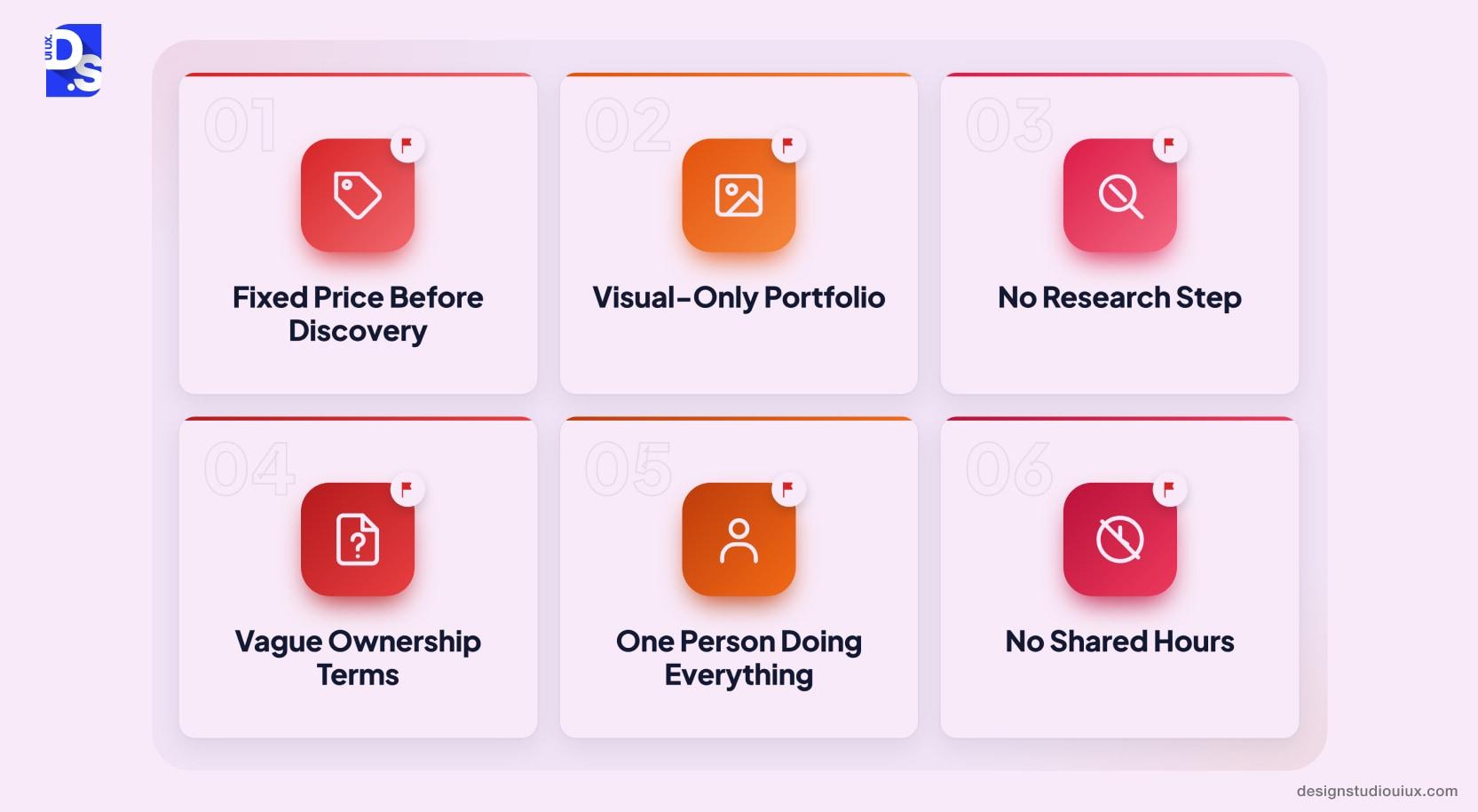
The clearest red flags when choosing a design partner are a quote without questions, a portfolio of finished visuals with no process, and no plan for research or testing. A good partner asks about your users and business goals before giving a price.
Watch for these warning signs:
- Fixed price before discovery: a quote given before the partner understands your users, scope or technical limits.
- Visual-only portfolio: polished screens with no explanation of the problem, process or results.
- No research step: design starts without talking to users or reviewing analytics.
- Vague ownership terms: no mention of copyright assignment or source file handover.
- One person doing everything: the same person sells, designs and manages, with no review behind them. Hiding information about the actual project team working the day-to-day design work is a major red flag.
- No shared hours: an offshore team that offers no overlap with your working day.
How do you work across time zones with an outsourced team?
Work across time zones by agreeing on two to four shared hours a day and moving routine updates to written, asynchronous tools. Keep the shared hours for design reviews and decisions rather than status updates.
India is 9.5 to 10.5 hours ahead of US Eastern time, depending on daylight saving. Teams in India commonly shift their working day so that their evening overlaps with the US morning. Latin American teams share most of the US working day, and Eastern European teams share the US morning.
Design Studio UI/UX works with US clients from 8 p.m. to 2 a.m. IST. That gives six shared hours a day: 9:30 a.m. to 3:30 p.m. US Eastern time, or 10:30 a.m. to 4:30 p.m. during daylight saving.
A simple working rhythm:
- Daily: a short written update in Slack or your project tool.
- Weekly: one live design review with recorded decisions.
- Every sprint: a demo of finished work against the agreed metrics.
What does a long-term outsourced UX partnership look like?
A long-term partnership looks like an external team that knows your users and product as well as an internal one. One example from our work is SmartMoving, a SaaS platform for moving companies based in Dallas, Texas, which has worked with Design Studio UI/UX as its design partner since 2018.
- Problem: moving companies relied on manual, fragmented tools, which caused lost leads and little real-time visibility into crews and jobs.
- What we did: interviewed 30+ dispatchers, drivers and clients, grouped 50+ operational tasks into three hubs, and consolidated 7+ legacy screens into single views.
- Result: conversion rose 54% and retention rose 36%, as reported in the SmartMoving case study.
More examples are in our UI/UX case studies.
Plan your outsourced UX project
If you are deciding whether to outsource UX design, start with a clear scope and a small first phase. Design Studio UI/UX provides UI/UX design services for SaaS, B2B and enterprise teams in the US and India, from UX audits to product redesigns and dedicated design support. Book a free scoping call to get a cost range and timeline for your project.
Summarize this article with AI
Frequently Asked Questions
How long does an outsourced UX design project take?

Most outsourced UX projects take 4 to 12 weeks. A UX audit usually takes 2 to 4 weeks and an MVP design 6 to 10 weeks. A full product redesign takes 3 months or more, depending on the screens and research involved.
Can a small startup afford to outsource UX design?
Yes. Startups can control cost with a fixed-price MVP scope or a UX audit before full design work. An agency in India, Eastern Europe or Latin America can cost a fraction of a US in-house hire while still covering research and UI design.
Is outsourcing UX design to India a good idea?
Outsourcing UX design to India can be a good idea for teams that plan for the time difference. Indian agencies sit in the lowest rate band in the Clutch data, and many work with US SaaS companies every day. Check case studies, shared hours and communication quality during a paid first phase.
Do outsourced UX designers work with our developers?
Yes, outsourced UX designers can work with developers directly. A good design partner prepares developer handoff in Figma, with specifications, components and states, and joins review calls with your engineers. Ask partners to show a past handoff file before you sign.
Can AI design tools replace an outsourced UX team?
Not fully. AI tools speed up tasks such as layout drafts, copy variations and research summaries. User research, product decisions and usability testing still need experienced designers who understand your users and business goals.
How do I measure whether an outsourced UX team is doing good work?
Measure the outcomes your users and business care about. Common metrics to be monitored are task success rate, time on task, onboarding completion, support tickets and conversion rate. Set a baseline before work starts and compare after launch.