


Not sure where to start? Most projects begin with a UX audit.
Talk to usRestaurant Internal Operations App Design &
Development for Soul Foods Group

- Soul Foods Group
- QSR Multi- Brand Franchise
- Internal App Design & Development
- 1 UX/UI Designer, 2 Developers
- Ongoing
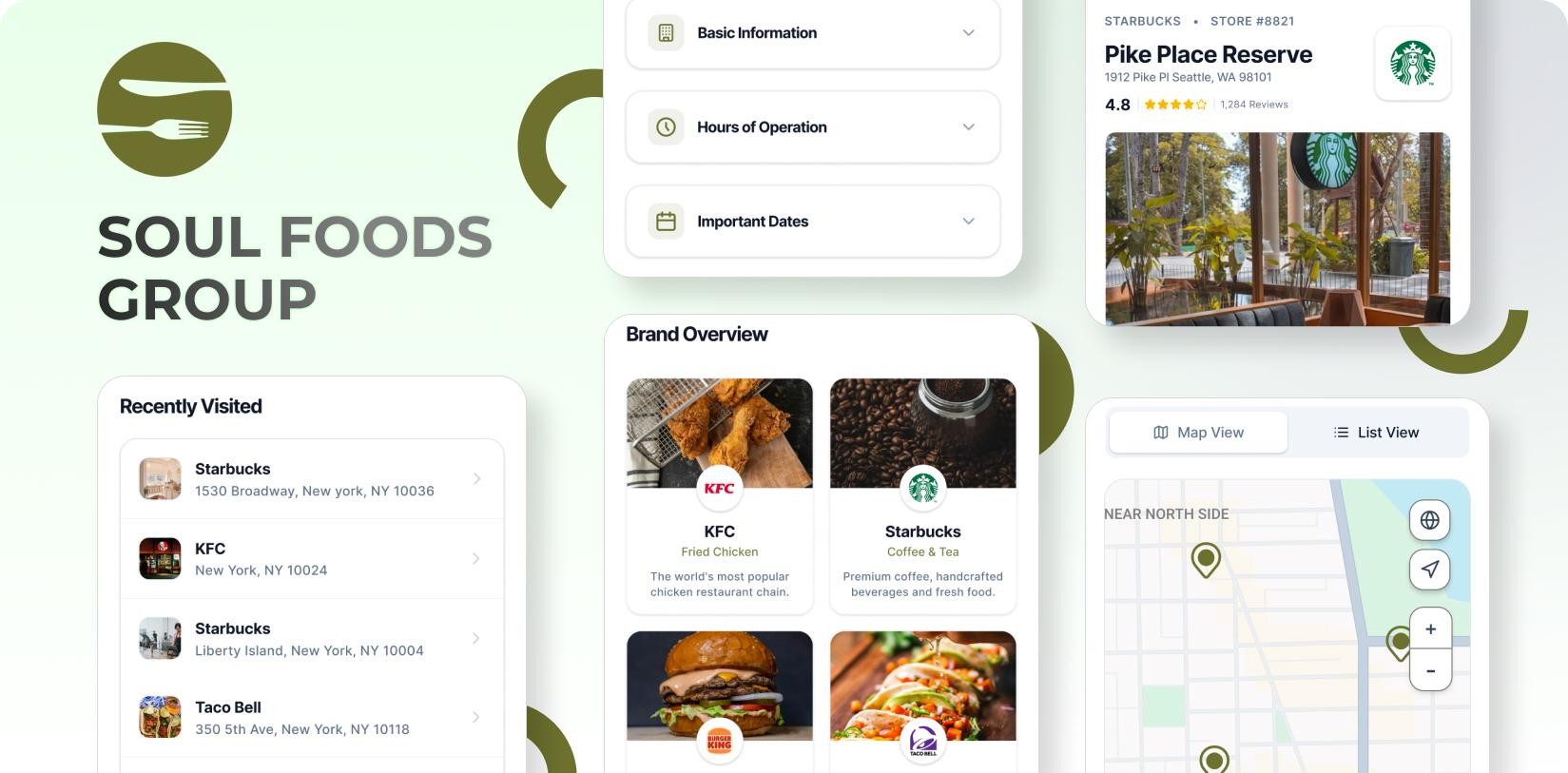
About Soul Foods Group
Aly Janmohamed started Soul Foods Group in 1985 with a single KFC in East Finchley, London. Four decades on, that one restaurant has become a portfolio of more than 400 locations across the UK and Canada, with a workforce of over 10,000 people.
The company manages four major brands of fast food powerhouses such as – Taco Bell, Burger King, KFC, and Starbucks. Every brand comes with its own rules, safety/compliance standards, and way of doing business. Keeping all these factions working perfectly across two different countries is a major headache for the management.
Soul Foods came to us because the tools holding the operation together had not kept up with the business. Spreadsheets, email chains, and disconnected systems were doing work that a proper platform should have been doing years ago.
Goal of the Design
When you run more than 400 restaurants in two countries, you can not afford communication delays. Area managers require quick updates about how their locations are doing. At the same time, executive teams in Toronto and Rickmansworth need to see exactly how the whole business is doing in real-time. This ensures no waiting time for compiled reports.
Soul Foods needed one platform purpose-built for their operation that gives every level of the business what they actually need, from daily checklists to cross-country performance views. That was the brief.
- Replace fragmented tools with one centralised platform: a single application covering outlet management, operational workflows, and performance tracking across all 400+ locations.
- Give operations teams daily-use tools that work: digitised checklists, structured workflows, and status tracking, replacing the email and spreadsheet processes that had become the default.
- Build cross-country visibility for leadership: real-time oversight of the full UK and Canada portfolio, without manual compilation or time zone delays in reporting.
- Design for the long term: a platform architected to grow alongside Soul Foods as the portfolio expands not something that needs a rebuild when they hit 500 restaurants.
Challenges
Running a business this size comes with structural complexity that most software isn’t built for. These were the real problems we had to solve:
Brands following different Operational and Compliance Standards:
- Food brands like Taco Bell, KFC, Burger King, and Starbucks do not run the same way. They follow unique franchise standards and audit rules. We need to design a single platform for Soul Foods that can easily adapt to all four distinct workflows. This will save the hassle of creating completely separate systems that just cause more confusion.
Spreadsheets Were Running the Business:
- Day-to-day business depended heavily on a mix of spreadsheets, chaotic email chains, and separate tools. Getting a clear report was a slow process. Teams had to manually follow up just to get updates. All the data was there, but it was not in one single place, which makes it quite frustrating to find it on time.
Two Countries, One Leadership Team:
- With the UK business headquartered in Rickmansworth and the Canadian operation based in Toronto, getting a consistent view of what was happening across both markets was difficult. Time zones didn’t help. Neither did having no shared system to look at.
No Unified View of 400+ Restaurants:
- Area managers were monitoring their locations through whatever tools were available, not through a designed workflow. For senior leadership, building a picture of the full estate meant waiting on reports rather than checking a dashboard. That kind of lag costs time and good decisions.
Our Approach
Discover
Soul Foods operates four brands across two countries. A single stakeholder session wasn’t going to tell us what we needed to know. We spent time with the people who would actually use this platform not just the people commissioning it.
Three distinct groups shaped the design direction from the start:
- Operational staff managing individual restaurant locations — needing fast, task-oriented tools that work during a busy shift
- Area managers overseeing multiple sites — needing clear status views, compliance tracking, and the ability to spot issues without visiting every location
- Senior leadership in Canada and the UK — needing a real-time, cross-portfolio picture without manual reporting in the way
- Each group had different priorities and a different idea of what ‘useful’ looked like. Getting that alignment early meant we designed the right product, not just a product.
Define: Application Architecture & Access Model
With the user research done, the central design question became: who needs to see what, and when? The answer shaped the entire application structure.
Role-based access became the backbone. Operational staff see what they need for their shift. Area managers get a multi-site view with compliance and performance indicators. Senior leadership gets the full cross-country picture. Each role gets a purposeful interface not a filtered version of the same screen.
We also mapped out how multi-brand compatibility would work in practice. How does one platform handle KFC’s daily checklists and Starbucks’s opening procedures without creating confusion or forcing users to navigate between entirely separate experiences?
The answer was a shared structural layer with brand-specific configurations a platform that adapts to each brand’s workflow rather than one brand’s logic applied to all four.
Design Highlights


This was an internal product, not a consumer app. Nobody’s discovering it in an app store or choosing it over a competitor. The people using it have a job to do, and the design either helps them do it faster or it doesn’t.
We designed the outlet dashboard to give any user an immediate read of what’s happening within their scope one restaurant, a cluster of sites, or the full estate. The hierarchy was clear: what needs attention now, what’s on track, what leadership needs to see.
After iterative design cycles and detailed client feedback reviews, we handed the development team:
- Our team followed operational standards and accordingly created a comprehensive UI library, interactive states, and important design styles. It is basically built to be brand-neutral so that any brand such as KFC, Taco Bell, Burger King, or Starbucks, can easily use it. Our team made sure that none of the designs favour any specific brand identity.
- Interactive prototypes for each role-based user flow validated with actual area managers and operational staff before a single line of code was written.
- Fully digitised workflow screens covering operational checklists, compliance tracking, performance dashboards, and reporting built to replace the spreadsheet and email processes entirely, not just sit alongside them.
Managing 400+ restaurants shouldn't depend on disconnected spreadsheets, endless follow-ups, and fragmented reporting. One platform now powers every brand, every outlet, and every decision.
- One Source of Truth:Operations teams, restaurant managers, and leadership now work from the same live data instead of multiple spreadsheets, manual reports, and disconnected communication.
- Real-Time Operational Visibility:Critical business information is available instantly, enabling faster decisions across brands, locations, and management teams without waiting for compiled reports.
- Digitised Restaurant Operations:Manual, paper-based, and email-driven workflows have been replaced with streamlined digital processes, allowing teams to spend less time on administration and more time running restaurants.
- Built for Scale: The platform is designed to support new restaurant launches, additional brands, market expansion, and future operational requirements without rebuilding the system.


Final ProductShowcase
We built a simple, practical internal tool that 10,000+ employees can actually get work done in. It is mainly made for managing 400 restaurants across two countries, four brands, and two time zones.
Internal tools rarely get the spotlight. But they’re often where the most meaningful design work happens. When an operations platform works the way it should, area managers spend less time chasing updates and more time managing their teams. That has a real effect on the 10,000 people doing the work every day.
This is what a purpose-built restaurant operations management app looks like not a generic SaaS product adapted to fit, but a platform designed around how Soul Foods Group actually operates.
See more of our work:
→ B2B Web App UI Design —Nexford University


UpcomingCase Studies











Happy Clients& Partners



“They gave a clear overview of the design and approval milestones and executed them accordingly. Communication and the work delivered were both top-notch. I’d highly recommend working with her!”



“We were looking for something creative and different from what everyone else was putting out there. And we found it with Design Studio. Great work!”


“Design Studio team were absolutely fantastic. Highly talented designers.”


“The DS team went beyond our UI redesign expectations. We are grateful for the work well done. Kudos.”


“The team was great, extremely communicative and patient with the project. I highly recommend it to anyone.”


“Design Studio did an awesome job. Their communication and timing were excellent. The quality of work was fantastic.”


“We’re thrilled with CRM Dashboard, Website design from scratch by Design Studio. They nailed the design and ensured flawless development and performance.”


“Design Studio created a beautiful, functional website and mobile app for us. Excellent communication and top-notch design!”


“Design Studio provided us with a sleek design and powerful backend development. Our user experience has improved dramatically.”
Got a Project in Mind?
Let's Talk!
 hello@designstudiouiux.com