

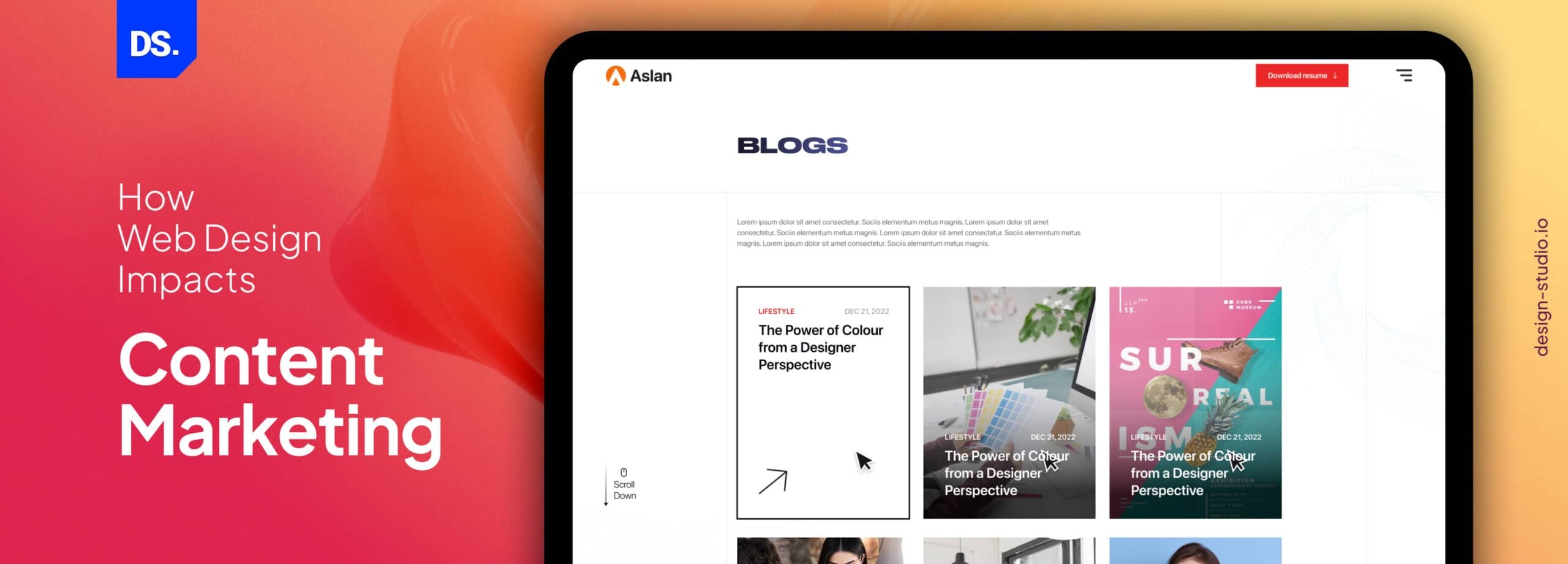
How Web Design Impacts Content Marketing (2026)



Web design and content marketing might look like two different entities, however, they are not. Every published content stays within a particular design, which helps users to read it, trust it, and take action, otherwise, it will disrupt the way.
In 2026, brands succeeding in content marketing have content teams and design teams working on the same goal; to help users find the correct information and take the right action.
In this turbulent economic environment, brands worldwide are employing cost-cutting measures to ensure their books stay balanced. One would assume that the content marketing departments at these brands would face the brunt of these cost cuts.
But, in 2024, that hasn’t been the case. According to a survey published in WordPress VIP’s “Content Matters 2024 Report”, that involved thousands of content marketers:
- 58.4% of content marketers claimed that they expect their budgets to increase this year.
- 49.2% of content marketers claimed that their content marketing budgets have grown consistently since 2021.
So, are content marketing departments immune to cost cuts?
Of course, not!
But, new-age businesses make safe, smart, and data-driven decisions on how to spend their marketing dollars.
Web design in general influences content marketing by improving the usability of the site, increasing the site’s relevance for search engines, and making the content more engaging.
When a Web site is properly designed or optimized and able to adapt to the screen size and resolution, it becomes easier to deliver information to the audience, and content gets consumed for longer periods of time leading to improved conversion ratios.
According to them, content marketing is one of the most effective avenues for marketing spend. In this article, we’ll define the concept of being successful at content marketing.
We’ll also discuss a hidden aspect of content marketing success: high-quality web design. But, first, let’s define content marketing success.
Web design is a factor behind the success of content marketing. A professional web design makes the content readable and scannable, adds a layer of trust, acts as a roadmap for users on their next actions, and uplifts the brand’s credibility and authority.
What Does It Mean to Be Successful at Content Marketing?

The success of content marketing boils down to: SEO performance, lead quality (MQL), share of voice against competitors, and the value of the lead.
As per WordPress’s VIP Content Matters Report 2024, 78% of organizations have observed the skyrocketing demand for content, but only 45% have sufficient budgets.
That’s why businesses leaning into a data-driven and design-optimized strategy will outpace competitors in 2026.
Content marketing is the practice of creating, publishing, and promoting content that is relevant to both your brand and your target audience. This content does not need to be outwardly promotional; it can be relevant and helpful for your target audiences.
It can also be something that generates strong interest in your brand or your industry.
Ever since the advent of search engines, content marketing and search engine optimization have been joined at the hips. The combination of these two practices has enabled brands to gain online visibility.
So, if a website’s SEO is fruitful, it’s highly likely that the site has a lot of high-quality content that people genuinely enjoy consuming.
WordPress VIP Content Matters 2024 report mentioned these to be the top three content creation challenges:
- (1) creating high-quality content
- (2) keeping up with trends
- (3) staying current with technology
all of which are directly addressed by investing in professional web design.
In addition to success in SEO, here are some other key metrics that professional content marketers use to determine whether or not their efforts are successful:
- The number of leads (Marketing Qualified Leads or MQLs) the content generates. For instance, if a user interacts with your content and is inspired to sign-up for your services, that counts as a lead.
- Lead engagement, i.e., a measurement of the quality of the leads one generates.
- Share of voice: a metric that defines how well your content boosts your brand in comparison to similar content published by competing brands.
- Share of search, i.e., the amount of search traffic received by your content relative to your competitors.
- Lead value, which is the multiplication of your brand’s traditional cost-per-lead (CPL) and the number of leads your new content marketing efforts generate.
- Lead attribution, which helps marketers understand the optimum marketing methods for generating leads.
How Does Web Design Directly Impact Content Marketing Performance?
Web design primarily affects content marketing in the following ways: making content scannable through visual hierarchy (comprehension), maintaining brand consistency for trust-building (uniformity through design), guiding users toward CTAs (user flow), and maintaining overall appearance for credibility.
Hubspot’s 2026 Marketing Statistics report reveals that a website/ blog/ SEO is still reigning as the best B2B ROI generation channel. These three components can only generate leads and the lead generation depends on web design quality.
Siege Media in its 2025 Content Marketing Statistics report expects 88.2% of businesses to increase their content marketing budget in 2025 and beyond.
These were just some metrics that you can use to determine the success or failure of your content marketing efforts. So, how does web design play a part in all these?
Well, a good web design helps your site visitors navigate through the content easily, thus making your efforts on content marketing successful.
Content-heavy sites can easily feel cluttered, and when that happens none of the content on these sites is accessible.
If you publish informational, entertaining, or promotional content on your website, it has to be easy to access, read, and understand. Web design plays a key role in this. Efficient web design can make your website’s content more accessible.
An efficient navigation design can guide more users toward the information published on your website.
Efficient page structuring and layout design can also help users easily navigate through pages of content to find the info they are searching for. These strategies are considered as best practices for web design for improving usability and reducing user frustration.”
Even a simple web design trick like creating a drop-down menu on your website can instantly make your website content ten times more accessible for the average visitor.
Overall, high-quality website design is the key to making the content you publish on your site more accessible to your target audience. But, that’s not all.
Website design can impact your content’s success in a multitude of different ways.
How Do Google’s Core Web Vitals Connect Web Design to Content Marketing SEO?
Google judges every content against some important performance metrics, also known as Google’s Core Web Vitals. Getting these parameters wrong will contribute to low rankings, even if the content is good.
| Core Web Vital | What It Measures | Design Decision That Controls It | Content Marketing Impact |
| Largest Contentful Paint (LCP) | How fast the main content of a page loads | Image compression, server response time, lazy loading above-fold content | Slow LCP means lower search ranking and less organic traffic to your content |
| Cumulative Layout Shift (CLS) | Whether page elements move unexpectedly as the page loads | Defined image/ad dimensions, stable font loading, no late-loading elements shifting content | High CLS = users lose their reading position = higher bounce rate |
| Interaction to Next Paint (INP) | How quickly the page responds to user clicks and interactions | JavaScript load optimization, efficient event handlers, clean code | Slow INP = frustrated users who cannot navigate to more content |
- If a page scores ‘Good’ on all Core Web Vitals, then the page is eligible for a boosted Google’s Page Experience, directly increasing its organic traffic.
- LCP should stay within 2.5 seconds, with 0.1 second improvement in mobile loading speed will lead to increased content consumption rates.
- The content of all pages should be run through Google PageSpeed Insights to track Core Web Vitals and understand which design elements are hurting content performance instead of helping.
What Are The Content Design Best Practices By Page Type
Different content pages have different design requirements. The layout for a 2000-word blog post will not work for a landing page or a case study page. This is a quick guide on the content and appropriate design type:
| Content Type | Primary Design Goal | Key Layout Elements | Avoid |
| Blog Post | Keep readers engaged from intro to CTA | Clear H2/H3 heading structure, short paragraphs, pull quotes, inline CTAs after key sections, table of contents for long posts | Long unbroken text blocks, CTAs only at the end, intrusive pop-ups that interrupt reading |
| Landing Page | Convert visitors to leads or customers | Single headline above the fold, one primary CTA (not multiple), social proof near the CTA, minimal navigation (no menu bar) | Multiple competing CTAs, long navigation menus, excessive scrolling before the CTA appears |
| Case Study | Build credibility and trust | Named client + logo, problem/solution/result structure, key metrics highlighted in a callout box, headshots or company photos | Anonymous vague claims, no specific numbers, stock photography instead of real client imagery |
| Resource / Guide | Drive downloads and email capture | Clear value statement, preview of what is inside, simple form (name + email only), social proof showing download count | Gated content buried behind 10-field forms, no preview of value before asking for email |
How Do Specific Web Design Elements Affect Content Marketing Performance?
This table maps how each web design element is directly tied to various content marketing outcomes. It will tell about which design improvements will significantly influence content performance metrics:
| Web Design Element | Content Marketing Impact | Metric Affected |
| Visual Hierarchy & Typography | Increases content readability and engagement | Bounce rate, time-on-page |
| Page Load Speed | 1-second delay reduces conversions by 7% | Conversion rate, SEO ranking |
| Mobile-Responsive Design | 60%+ of web traffic is mobile; non-responsive sites lose rankings | Organic traffic, mobile conversion rate |
| Clear Navigation Structure | Reduces website abandonment; improves page depth | Pages per session, MQLs |
| CTA Design & Color Contrast | Bright CTAs yield higher conversion rates | Conversion rate, lead gen |
| Brand Consistency | Familiarity drives loyalty and return visits | Return visitor rate, brand recall |
| White Space & Content Layout | Broken sections increase readability and scroll depth | Engagement rate, scroll depth |
How Does Web Design Improve Content Comprehension and Readability?
Web design improves reading comprehension through visual hierarchy (size, color, contrast, and white space) to break content into scannable chunks and remove user’s effort.
Siege Media’s 2025 content research report mentioned that blogs with relevant images are 94% more likely to get views and traffic, affirming that content design is also an important factor.
Visual content is 43% more impressive than text-based interfaces. Cluttered interfaces disrupt content quality, signalling that the web design quality is one of the best improvements to consider.
If a piece of content is not clear, concise, and well-presented, it will fail to engage people. Web designers deal with the latter.
They create clear visual hierarchies on web pages so that users can easily scan through them and engage with the most eye-catching pieces of content.
This involves the use of many web design techniques, especially the tactical use of white space and typography.
Would you like to read a continuous block of text or the same content broken into small sections? Certainly, everyone will prefer the latter, and web designers have to address this preference by reducing clutter and providing individuality to each piece of content on a website.
Mobile Content Design: Why Your Layout Choices Are A Content Marketing Decision
Web traffic comprises 60% of mobile users. This plays into the content marketing team’s strength, as the majority of your readers are reading articles, guides, and landing pages on a 6-inch screen.
So the content that looks well on a 27-inch desktop screen might not work on a small phone.
So, these rules should be followed to maintain consistency:
- The paragraph length should be capped at 3-4 lines maximum, as mobile users won’t read long paragraphs, unlike desktop readers
- The font size should be 16px for body content to ensure users can read without zooming, small fonts will lead to higher bounce rates
- Long-form content of 1500+ words should have a “Table of Content”, a sticky or anchor-linked table of contents will help users to directly navigate to the specific section, thus decreasing bounce rate
- Mobile users often skim through the content by going through images, standalone image captions that act as mini-summaries help users to do just the same.
- CTAs should be placed strategically, lead generation CTAs (newsletter sign-ups, content downloads, and demo requests) should be placed after third or fourth section, as mobile readers almost never reach the footer
- The content pages should be tested on a real phone, the blog posts and guides should be opened on mobile devices and read from start to finish, the points you are facing friction is where your readers are also experiencing them
Why Is Brand Consistency in Web Design Critical for Content Marketing?
Consistent web design aka using the same fonts, color, and layout across all website pages creates familiarity and trust, driving repeat customers, visit rates, and the quality of MQL.
Stanford’s Web Credibility Project treats design consistency as a top selection criteria of trustworthiness.
Any inconsistency in design quality will undermine the brand’s content credibility and professionalism.
The average Internet user determines whether a webpage is useful or not in less than 0.05 seconds. Stanford’s Prominence-Interpretation Theory, later corroborated by NNG stated that website design quality is the primary factor driving first-impression & credibility.
So, if your website is confusing to navigate, it will be deemed “unusable” by a lot of people pretty quickly. No amount of high-quality content will convince them otherwise.
That’s why web designers have to maintain a certain level of design quality across all pages on a website.
That means keeping fonts on all content pages consistent, using a clear method of structuring and spacing content, and using the same color palette across all pages. Such consistency in design quality creates a sense of familiarity in the minds of target audiences.
This sense of familiarity is vital for creating a base of loyal customers on any website.
Plus, the design choices that professional web designers make are all rooted in years of research. For instance, some studies suggest that bright-colored call-to-action (CTA) buttons on websites yield higher conversion rates.
Data from NNG shows that CTA buttons with unconventionally attractive colors will see higher click-through rates.
Hence, a smart web designer will ensure all primary CTA buttons feature eye-catching colors instead of dull or dark ones.
How Does Web Design Guide Users Through the Content Marketing Funnel?
Web design helps users move through the content marketing funnel by using visual hierarchy, color contrast, whitespace, and CTA placement toward desired actions, signing up, downloading, or purchasing.
Nielsen Norman Group in the Prominence-Interpretation theory said that users notice design elements that stand out from the rest, meaning CTA button design, contrast, and placement are as important as the copy itself.
Website content is often shaped to guide users to take specific actions. Making all content pages super-easy to navigate is an easy way of achieving this goal.
Good content can inspire your target audiences to take the steps you desire, only if it is easy to understand and navigate through. Web designers can add this quality to your content by adding visual hierarchy, scale, whitespace, color contrasts and other design elements to your site’s content pages.
How Does Website Appearance Affect Content Credibility and Trust?
Website appearance has a significant impact on content credibility; as users because users make trust judgments in under 0.05 seconds, primarily based on visual design quality, before reading any content.
According to the Stanford Web Credibility report, a professional website will gain better credibility ratings compared to a poorly designed website with high bounce rates and low content value.
NNG’s UX Metrics & ROI report states a professional UX design can improve business outcomes by 83%, which includes organic traffic, time-on-page, and conversion rate.
Even if your website content is SEO-optimized and super-easy to discover, users may turn away if it is not designed or presented well. Websites that look and feel outdated don’t attract many readers.
Web designers can add a sense of visual appeal and professionalism to your content and make it appear more trustworthy to visitors.
Final Take
Professional web designers have spent decades designing content-friendly websites. They know exactly what the average internet user is looking for in websites in terms of presentation, aesthetics, and visual appeal.
If you publish content on your website, a good web designer offering top web design & UI UX services can take your content to the next level and help you secure more traffic, leads, and overall content marketing success!
FAQ,s About Web Design Impacts Content Marketing
How does web design affect content marketing success?

Web design influences how users can access, read, and decide what to do with the published content. If the website has poor navigation, or too chaotic interface, doesn’t load within 2 seconds, and has an inconsistent branding, it will suffer from poor conversion and content consumption rates. On the other hand, a professionally redesigned website UX scored 83% in terms of traffic, engagement, and conversion rates.
What is the ROI of investing in web design for content marketing?
As per Hubspot’s 2026 Marketing Statistics, a SEO optimized website/ blog is the best ROI generation channel for B2B brands. An improvement in web design will increase the website’s conversion rate, incoming traffic, and lead quality.
What content marketing metrics does web design influence?
Web design has a direct impact on: i. Marketing Qualified Leads via CTA design and layouts optimized for conversion, ii. Bounce rate through navigation clarity and visual hierarchy, iii. Time-on-page (content structuring and readability), iv. Share of voice (brand consistency), v. Lead value (better trust signals through professional design).
Why is brand consistency in web design important for content marketing?
Brand consistency in web design creates familiarity across all content touchpoints, building trust and loyalty with repeat visitors. Stanford identifies consistent, professional design as one of the top metrics users use to judge website trustworthiness. Design inconsistency like mismatched fonts, color shifts, layout variations breaks user confidence and reduces the effectiveness of every piece of content published.
Are content marketing budgets increasing despite economic uncertainty?
At a glance, yes, but there’s nuance to it. WordPress reports that only 45% of content marketers will have a considerable marketing budget in 2024, a 13% reduction compared to last year. Another media report mentioned that 88% of content marketing budgets are likely to grow or stay the same
How does web design help with content marketing SEO?
Web design helps content SEO through: (1) clear site structure; (2) mobile-responsive design satisfies Google’s mobile-first indexing; (3) page speed optimization improves Core Web Vitals scores; and (4) low bounce rates, driven by intuitive design, signal content value to Google’s ranking algorithm.
What does a web designer do to improve content marketing performance?
A web designer improves content marketing performance by making the content scannable; focusing on mobile-responsive layouts; implementing brand-consistent design across all pages; optimizing CTA buttons and placing them strategically for optimal conversion; and structuring page layouts to guide users through the funnel; and ensuring page speed supports both UX and SEO.