


Pharmastock: Medical & Surgical
Inventory Management System

An Inventory Platform Designed For Scaling Healthcare Operations
- Pharmastock
- Healthcare
- Dashboard Design
- 9 - 12 months
Project Overview
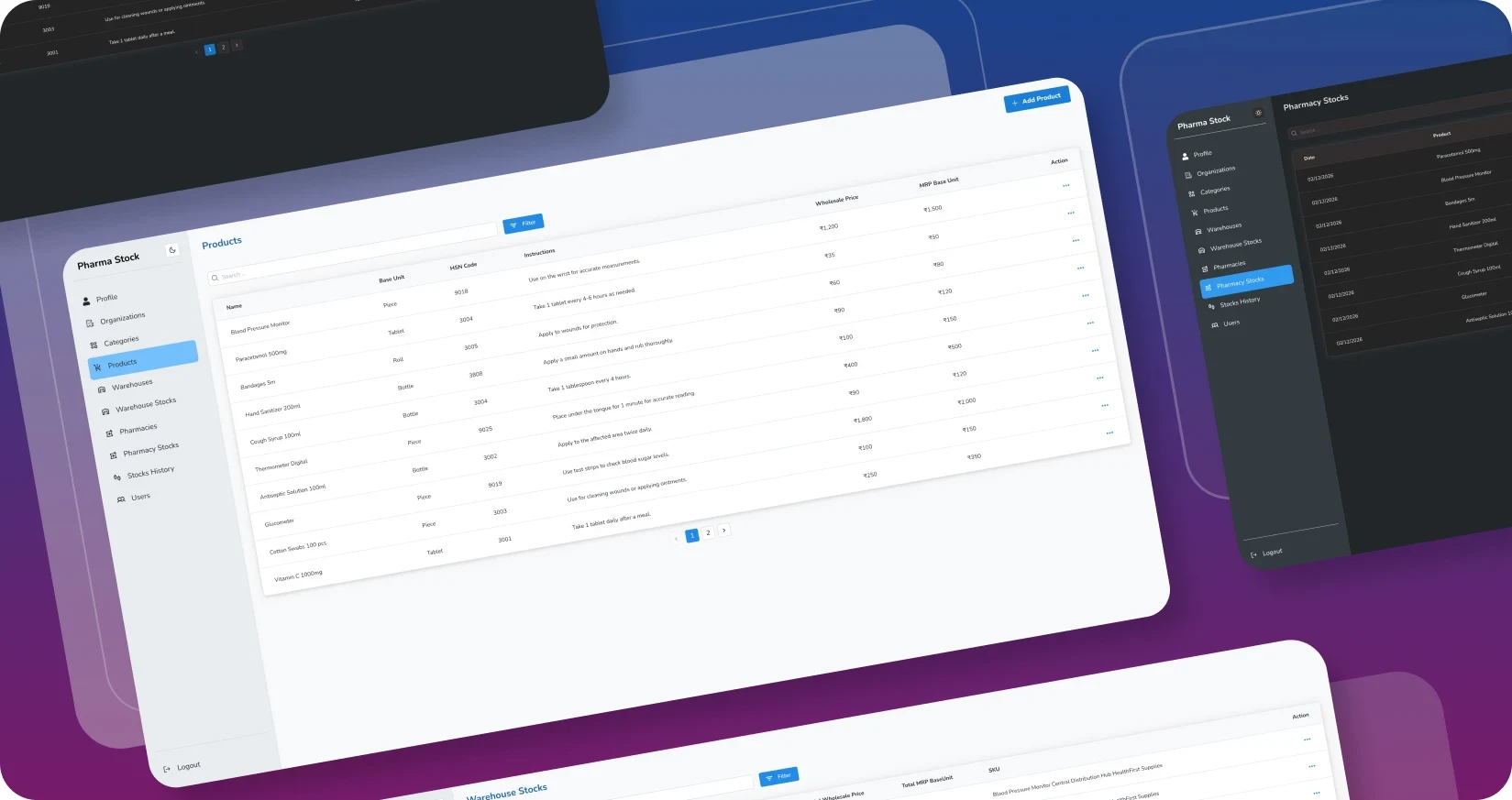
Pharmastock is a role-based, centralized inventory management system to provide a comprehensive view of medical and surgical inventories across warehouses and pharmacies. It covers an end-to-end view of procurement & distribution along with batch tracking, expiry management, and audit-ready inventory logs. As an enterprise UX design, it helps these organizations to maintain data security, accountability, and compliance.
Who this System is Designed for
Pharmastock is an inventory management system that helps organizations accurately manage and trace inventory in daily operations.
It is particularly suited for:
- Hospital groups and healthcare networks requiring B2B website design for managing inventory across departments and locations
- Medical and surgical distributors handling batch-sensitive supplies
- Multi-branch pharmacies receiving stock from centralized warehouses
- Healthcare operations and procurement teams responsible for compliance and audit readiness
This platform is designed to minimize inventory errors, operational risk, financial loss, or regulatory issues.
Planning a healthcare or enterprise inventory system?
See how we design secure, scalable, audit-ready platforms.
The Challenges
The medical and surgical inventory management was chaotic and siloed, without a centralized inventory management system.
This led to:
- Inconsistent identification of medical items
- Limited visibility into real-time stock levels
- Difficulty tracking batch-wise and expiry-sensitive supplies
- Higher losses due to expiry, mismanagement, and manual clearance
- Higher losses due to expiry, mismanagement, and manual clearance
As operations grew, these gaps increased operational risk and made compliance and audits harder to manage.
Our Design Approach

At Design Studio UI/UX, we approached Pharmastock as a system design challenge, not just a dashboard.
Our UX strategy focuses on:
- Standardizing inventory without adding complexitys
- Designing workflows around real operational roles
- Making accountability and traceability part of the UX
- Ensuring the Information Architecture could scale across organizations and locations
The result was a platform that feels structured, predictable, and easy to operate—even with complex inventory rules.
Key UX & System Design Decisions
Pharmastocks is responsible for shaping foundational design decisions, such as
- SKU-first inventory structure: Standardized SKUs can establish consistency across warehouses and pharmacies without complicating reporting and reconciliation.
- Role-driven workflows: Each role has some specific actions, leaving no room for ambiguity.
- Warehouse-led inventory logic: Warehouses act as the source of truth, a true marker of an enterprise design system, making downstream pharmacy stock easier to track and audit.
- Auditability by default: With Pharmastock, healthcare organizations can automatically track stock movements, adjustments, and clearances, thus removing reliance on manual documentation.
Solution Summary
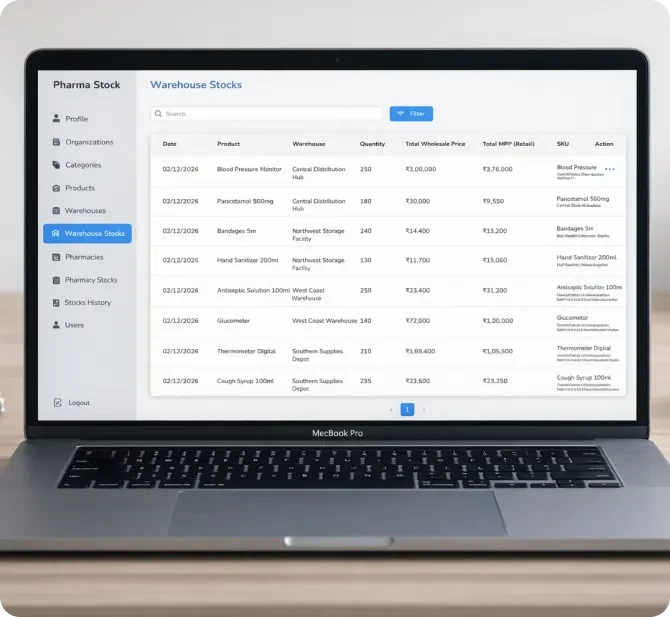
We designed and developed a centralized inventory management system that standardizes medical and surgical supplies using SKU-based identification.
The platform enables:
- Real-time stock visibility across warehouses and pharmacies
- Batch and expiry-aware inventory movements
- Role-based access control for secure operations
- Detailed audit trails for compliance and accountability
Every inventory action is traceable, reducing errors and losses while improving day-to-day efficiency.

Struggling with inventory chaos, compliance risk, or siloed systems?
We design UX that brings clarity, control, and accountability.
System Architecture Overview
1. Organizational Management
Organizations act as top-level entities within the platform, enabling true multi-tenant usage.
Each organization can manage:
- Multiple warehouses
- Multiple pharmacies
- Users with defined roles and permissions
Core organizational details such as name, location, and operational status ensure clean separation of data while allowing the system to scale.
2. User & Role Management
Users are linked to a single organization and assigned a role that defines their permissions.
Roles are configured using structured permission sets, allowing:
- Secure access control
- Clear responsibility ownership
- Controlled inventory operations
This ensures accountability across teams and simplifies audits.

3. Warehouse Management
Warehouses serve as central inventory hubs.
Each warehouse:
- Secure access control
- Has assigned administrators
- Maintains item-level stock records
- Acts as the primary source for pharmacy distribution
Location and area details help support multi-warehouse operations.
4. Item & Category Management
Medical and surgical items are defined with complete operational details, including:
Each organization can manage:
- Pricing and GST
- HSN codes
- Base units and usage instructions
Items are organized using hierarchical categories with flexible many-to-many relationships, allowing better classification and reporting.
5. SKU Generation & Inventory Identification
Each item is assigned a dynamically generated SKU based on:
- Organization
- Warehouse
- Item
SKU records track:
- Stock thresholds
- Current stock levels
- Stock status indicators
6. Stock Management (Warehouse Level)
Stock records represent final item quantities available at a warehouse.
Each update is timestamped, ensuring:
- Accurate quantity tracking
- Complete traceability
- Audit-ready inventory data

7. Stock Movement Tracking
All inventory transactions are logged, including:
- Incoming stock
- Transfers from warehouse to pharmacy
- Batch-wise and expiry-aware movements
- Adjustments linked to clearance operations
Each record captures quantity, batch details, expiry dates, and references—ensuring full visibility across the supply chain.
8. Pharmacy Management
Pharmacies operate as distribution or consumption points within an organization.
Each pharmacy:
- Receives inventory from warehouses
- Maintains its own stock records
- Stores location and contact information
This enables decentralized operations without losing centralized control.

9. Pharmacy Stock & Clearance Management
Pharmacy-level inventory tracks:
- Item quantities
- Source warehouse
- Batch and expiry details
Clearance workflows handle expired, damaged, or unusable items, with logs maintained for compliance and accountability.
Impact & Outcomes
The Pharmastock system delivered clear operational improvements:
- Improved real-time visibility across warehouses and pharmacies
- Reduced losses due to expiry and mismanaged stock
- Stronger compliance through audit-ready inventory logs
- Clear role accountability across teams
- Scalable architecture supporting multi-organization growth

Designing a regulated, multi-role, enterprise platform is complex.
Our UX systems are built to scale without breaking operations.
How UX Reduced Operational Risk
A thorough UX audit plays a vital role in identifying the weak points and minimizing everyday operational risks.
By designing clear workflows, predictable system behavior, and role-specific access, the platform reduced:
- Manual errors during stock updates and transfers
- Unclear ownership of inventory actions
- Delays caused by missing or inconsistent information
As a result, teams could manage inventory with greater confidence and fewer exceptions.
Built for Scale and Growth
Pharmastock was designed to support growth without compromising control.
The system can scale across:
- Multiple organizations operating within the same platform
- Expanding warehouse and pharmacy networks
- Increasing inventory volume and item categories
Configurable roles, SKU-driven identification, and modular system design ensure the platform remains reliable as operations evolve.
Looking to Build or Scale a Healthcare Inventory System?
If you’re planning a medical, pharma, or enterprise inventory platform, we help teams design systems that are intuitive to use and built for long-term scale.
Explore how Design Studio UI/UX approaches complex product and system design through these UI/UX design case studies.
Why This Case Study Matters
- This project highlights how thoughtful UX and system design can simplify complex healthcare operations.
- A Pharmastock combines role-based access, SKU standardization, and inventory tracking to assist healthcare organizations in managing inventories with accuracy and control.
- At Design Studio UI/UX, our specialty lies in designing clear, scalable, and compliant B2B enterprise systems
Upcoming Case Studies


Happy Clients & Partners



“They gave a clear overview of the design and approval milestones and executed them accordingly. Communication and the work delivered were both top-notch. I’d highly recommend working with her!”


“We were looking for something creative and different from what everyone else was putting out there. And we found it with Design Studio. Great work!”


“Design Studio team were absolutely fantastic. Highly talented designers.”


“The DS team went beyond our UI redesign expectations. We are grateful for the work well done. Kudos.”


“The team was great, extremely communicative and patient with the project. I highly recommend it to anyone.”


“Design Studio did an awesome job. Their communication and timing were excellent. The quality of work was fantastic.”


“We’re thrilled with CRM Dashboard, Website design from scratch by Design Studio. They nailed the design and ensured flawless development and performance.”


“Design Studio created a beautiful, functional website and mobile app for us. Excellent communication and top-notch design!”


“Design Studio provided us with a sleek design and powerful backend development. Our user experience has improved dramatically.”
Got a Project in Mind?
Let's Talk!
 hello@designstudiouiux.com


